


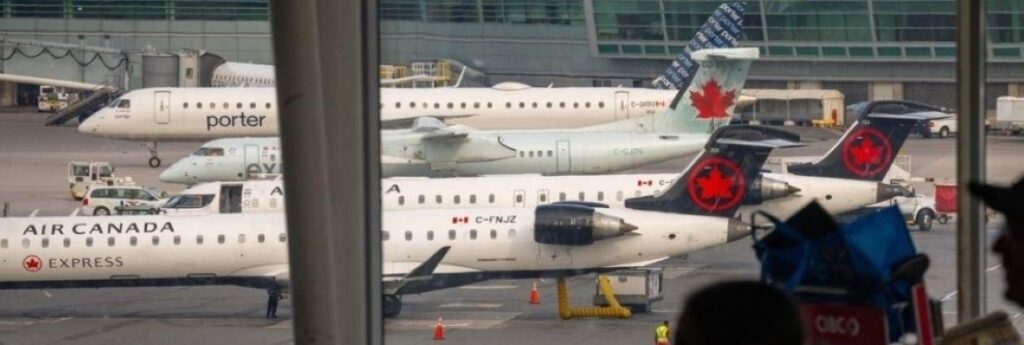
A work stoppage looms for around 10,000 Air Canada flight attendants after their union and the airline issued 72-hour strike and lockout notices, respectively, early Wednesday morning. The airline says it will begin cancelling flights that were scheduled to take off today (Thursday), with increasingly more disruptions by the weekend if a last-minute deal can’t be reached before the work stoppage takes effect. Here’s what else you need to know – and what’s next.
Have the strike and lockout started?
Not yet. The Air Canada component of the Canadian Union of Public Employees has signalled its intent to go on strike as of early Saturday morning.
That notice was issued just before 1 a.m. ET on Wednesday. Half an hour later, Air Canada issued a notice that it also plans to lock out flight attendants.
Such notices were required 72 hours in advance of any labour action. That means the work stoppage would officially begin Saturday around 1 a.m. if the two sides don’t reach an 11th hour deal.
Will all Air Canada flights be cancelled?
A work stoppage will affect Air Canada’s main operations and Air Canada Rouge.
Air Canada said it will begin a gradual suspension of flights in advance of the strike deadline to allow an orderly shutdown leading up to Saturday. The airline said the first flights will be cancelled Thursday, with more Friday and a complete stoppage by the weekend.
Flight attendants working for Jazz and PAL, which operate Air Canada Express flights, are not part of the negotiations. Flights under those banners will continue to operate as normal.
What to know about an upcoming flight?
- Air Canada has said it will notify customers via email and text message if their flights have been cancelled.
- Affected customers will be eligible for a full refund, which can be obtained through Air Canada’s website or mobile app.
- Arrangements have been made with other Canadian and foreign carriers to provide customers alternative travel options and customers will be notified of alternative travel options that are identified for them where possible. That includes passengers whose itineraries change mid-journey.
- Air Canada has undertaken other measures to mitigate the impact on customers including implementing a flexible rebooking policy for all customers, so they can change or defer travel at no additional cost. Air Canada will in all cases inform passengers of their rights under applicable rules if their flight is cancelled or delayed and meet its regulatory obligation.
- The airline has cautioned that under Canada’s Airline Passenger Protection Regulations, customers are not eligible for compensation for delayed or cancelled flights, meals, hotels for situations outside the carrier’s control, such as a strike or lockout; however, the airline is responsible for its decision to “pre-emptively” cancel flights in anticipation of a strike or lockout that has not yet started, said Air Passenger Rights advocacy group president Gabor Lukacs in an online post, who called it a business decision over which Air Canada has full control, and it is not required for safety reasons.”
- Air Canada recommends against customers going to the airport unless they have a confirmed booking and their flights are showing as operating on aircanada.com or the mobile app. Customers are also advised to use self-service tools as contact centre wait times are expected to be highly elevated.
What is this dispute all about?
The union has said its main sticking points revolve around what it calls flight attendants’ “poverty wages” and unpaid labour when planes aren’t in the air. It told members it has put forward a proposal seeking cost of living enhancements each year, with a catch-up “to where we should be at for 2025.”
CUPE said entry-level Air Canada flight attendants’ wages have increased 10%, or $3 per hour, over the past 25 years, which has been far outpaced by inflation.
It also said flight attendants are not paid “for a significant portion of their time on the job,” such as when performing safety checks, attending to onboard medical and safety emergencies, and assisting passengers with boarding and deplaning.
Air Canada said its latest offer included 38% total compensation increases over four years, including 25% in the first year. It said that proposal also addressed the issue of ground pay, improved pensions and benefits, increased crew rest and other enhancements to work-life balance.
The airline said that offer would make its flight attendants the best compensated in Canada. But it said the union submitted a counter-offer “seeking exorbitant increases beyond those presented in earlier submissions.”
What’s next?
Federal Jobs Minister Patty Hajdu said in a statement she has been meeting with Air Canada and its flight attendants throughout the negotiations, including on Tuesday. “I am closely monitoring the situation and encourage both parties to stay at the table until a deal is found,” she said.
“Federal mediators will remain available until a deal is reached. The best agreements are the ones the parties reach themselves. Canadians expect them to reach a deal one way or another.”
If this article was shared with you by a friend or colleague, you may enjoy receiving your own copy of Travel Industry Today with the latest travel news and reviews each weekday morning. It’s absolutely free – just CLICK HERE.