


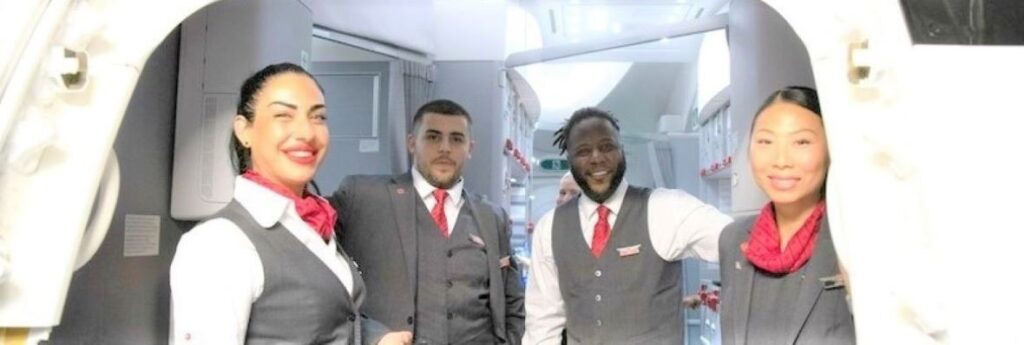
With an online petition – and some chirping on social media – of nearly half (4,800) of Air Canada’s 10,000 flight attendants expressing dissatisfaction over the airline’s wage offer, union members begin voting today (Aug. 27) on a new tentative agreement.
The agreement between the airline and union negotiators raises wages and establishes a pay structure for time worked when aircraft are on the ground. Terms of the tentative deal shared by the Air Canada component of the Canadian Union of Public Employees on its website include a 12% salary increase this year for most junior flight attendants, while more senior members are set for an 8% pay bump.
All members are set for a 3% increase in 2026, followed by 2.5% in 2027 and 2.75% in 2028.
The proposed deal must be ratified by the flight attendants, with a voting continuing through Sept. 6.
However, while members are set to vote on the full package, a large chunk of the terms within it – such as those setting out rules for pensions and retirement bridging, health benefits, prone rest and vacation – are already considered final, as agreed to by both Air Canada and the union.
If the deal is not ratified by union membership, CUPE said all terms excluding those surrounding wages would still form part of the new collective agreement for Air Canada’s flight attendants.
The wages portion of the agreement would then proceed to arbitration, where a third-party arbitrator would make a final decision.
The tentative agreement, which would run until March 2029, addresses the contentious issue of unpaid work while airplanes are not in the air.
Starting this year, flight attendants would receive half their hourly wage rate for 60 minutes of ground time on narrow-body aircraft and 70 minutes on wide-body planes. That would rise to 60% of the hourly wage rate next April, 65% in 2027 and 70% in 2028.
The terms surrounding ground pay are also considered final, regardless of the results from the upcoming ratification vote.
York University labour professor Steven Tufts said the end to unpaid ground work for Air Canada’s flight attendants could set a precedent for the industry.
“The majority of carriers still and historically did no ground time. They put everything into the rate for time in the air,” he said. “Now that the flagship carrier has it, I think the other small airlines will be more likely to follow suit.”
Tufts noted the ground pay terms of the Air Canada deal are similar, but not identical, to provisions at Delta Air Lines in the U.S. Delta, whose flight attendants aren’t unionized, in 2022 started paying for ground time at half the hourly rate, capped around 50 to 60 minutes.
“I think what happened is that the parties actually looked at that agreement and … did not necessarily borrow the language, but they borrowed the model,” he said.
Last year, American Airlines flight attendants also secured pay for boarding time through a union contract. Air Transat flight attendants tried but were unable to get it established during contract talks early last year, Tufts added.
It’s also likely to be a key issue for WestJet flight attendants whose contract concludes at the end of 2025.
“This has been a global campaign. It’s just not Air Canada flight attendants. And this is something that’s been overdue,” Tufts said.
If this article was shared with you by a friend or colleague, you may enjoy receiving your own copy of Travel Industry Today with the latest travel news and reviews each weekday morning. It’s absolutely free – just CLICK HERE.