


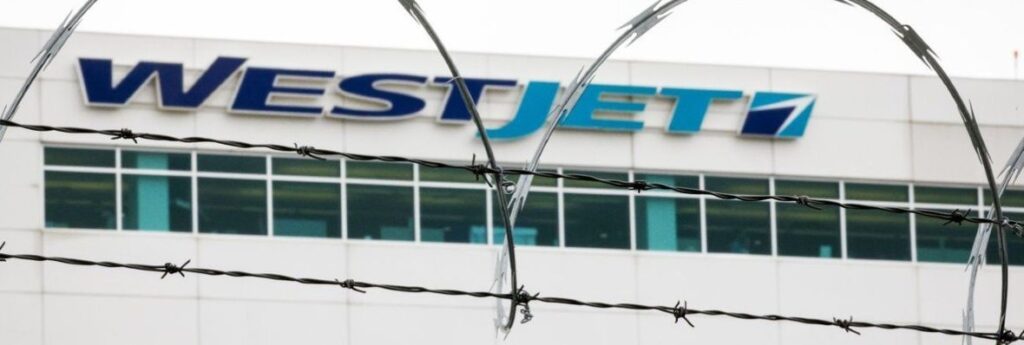
WestJet and the union representing some 4,400 flight attendants have agreed to an “operational wind-down” plan should a strike go ahead as soon as this Sunday. With the clock ticking down, the two sides this week inked an agreement that lays out how to ground planes and get cabin crew back home in the event of a work stoppage.
Unless a deal is reached, some flights could start to be grounded by Friday. Past airline labour standoffs have prompted a ramp-up in flight cancellations a couple of days before a strike, which must be preceded by a 72-hour warning from the union.
The deal between the two sides allows cabin crew working a flight when any job action kicks off to complete the trip to its destination. Those who can’t immediately return to their home city would receive hotel accommodation for up to a week or a plane ride back to another Canadian city, “subject to seat availability.”
The document underscores the looming possibility of a labour disruption, and comes after cabin crew at the Calgary-based airline voted 99% in favour of a strike mandate in mid-July. Since then, bargaining teams in that city have conducted intense negotiations in hotel conference rooms on a new contract as a mandatory cooling-off period draws to a close.
WestJet says passengers with flights scheduled any time between July 30 and Aug. 4 can make a one-time change or cancel it with no fee.
Travellers booked on its regional WestJet Encore service or code-share flights run by an airline partner such as Delta Air Lines will not be affected by a strike, the carrier said.
Compensation for work done on the ground remains a key stumbling block in the talks, less than a year after the same issue sparked a work stoppage by 10,000 flight attendants at Air Canada.
“The sticking point right now for us is unpaid work and how our wage is triggered. In addition to that, it’s our actual wage rate,” said Alia Hussain, who chairs the union’s WestJet contingent, in an interview outside the Calgary airport earlier this month.
“We believe that there is a large amount of unpaid work, which is why this remains an outstanding issue at the bargaining table.”
WestJet CEO Alexis von Hoensbroech has pointed out that strike authorization is a typical step during negotiations “and does not mean a strike will occur.”
“We are steadfast in our commitment to reach a meaningful agreement with CUPE that recognizes the contribution and professionalism of our cabin crew members and keeps WestJet competitive and sustainable,” he said in a recent statement.
Even a brief shutdown would cost WestJet millions of dollars during the height of summer travel – on a long weekend across much of Canada – said John Gradek, who teaches aviation management at McGill University.
“WestJet can’t afford a complete shutdown during their peak summer travel period,” he said.
The airline operates more than 600 flights per day carrying legions of passengers – more than 70,000 on some days, according to the company.
The Canadian Union of Public Employees has been ratcheting up a public relations campaign in recent weeks, launching a “day of action” with rallies across the country on July 14.
At the Calgary rally, some 250 WestJet flight attendants stood side by side in front of the carrier’s headquarters to send a message to management. Appearing in uniform, they held signs reading, “Ready to Strike,” “Unpaid work won’t fly” and “Frustrated with WestJet? So are we.”
Ads arguing the cabin crews’ case have popped up on platforms ranging from podcasts to TikTok content creator videos.
Customers whose flights are called off ahead of the potential strike or during it have the right to rebook free of charge on any airline – not just WestJet – says Air Passenger Rights president Gabor Lukacs.
For flight cancellations before a job action, the airline also owes customers up to $1,000 in cash for the inconvenience, he said. For cancellations during a strike, refunds are an option instead of rebooking.
Whether a strike goes ahead may hinge largely on where the two bargaining teams land on ground pay as well as wage rates more broadly. So-called boarding pay remains a major point of contention after Air Canada flight attendants in February secured compensation for ground work that will climb to 70% of their hourly rate for the hour before takeoff.
If you enjoyed or found this story useful, we’d appreciate if you would forward it to a colleague or friend who may also enjoy it. If, on the other hand, a friend shared it with you, welcome! You can get all the latest travel news and reviews from Travel Industry by simply clicking HERE.