


Israel’s military says Iran has launched missiles toward neighbouring Jordan and warned that fire could spill over across its borders. The military warned people Sunday to expect the first air raid sirens in weeks. It said Iran launched missiles toward the nearby Jordanian port city of Aqaba.
Israel, which joined the United States in launching the war with airstrikes on Iran on Feb. 28, has refrained from reentering the fighting since it reignited.
Since its ceasefire with the United States collapsed last week, Iran has focused its attacks on U.S.-allied Arab states in the Gulf as well as Jordan, rather than Israel. But an Iranian strike on Israeli territory could risk widening the conflict once again.
U.S. airstrikes
Meanwhile, the U.S. military launched airstrikes Sunday targeting Iran’s paramilitary Revolutionary Guard to retaliate for the killing of American troops in Jordan, further widening the exchange of fire between them as an interim deal seeking an end to their war has collapsed.
The strikes are part of a weeklong campaign that began with a struggle over control of the Strait of Hormuz and has seen Iran strike U.S.-allied countries across the Middle East.
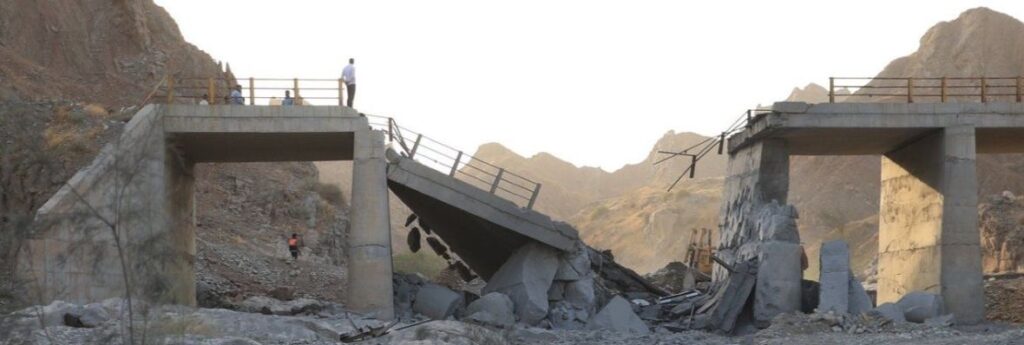
The U.S. has targeted bridges, electrical facilities and other targets in Iran, and Tehran has retaliated by hitting power and desalination plants in Kuwait, threatening daily life in that small, oil-rich desert nation.
Iran also has stepped up its threats to further expand the strikes, drawing a warning overnight from the United Arab Emirates.
Kuwait and Bahrain again activated air defenses Sunday morning as they warned of incoming Iranian drones and missiles.
Gulf states
Nearly every Gulf Arab state has been targeted by Iran for retaliatory strikes
Kuwait said on Sunday that one of the country’s power and water desalination plants was attacked for the second time in two days, causing fires. Its Ministry of Electricity, Water and Renewable Energy said that the power grid remains stable, yet the attack marked the latest instance in which strikes — by both the United States and Iran — have targeted civilian infrastructure relied on by millions of people.
In Kuwait, about 90% of drinking water comes from desalination.
The attacks in Kuwait and Bahrain were the latest reported by U.S. allies in the Persian Gulf as well as in Jordan.
Iran has over the past week refrained from striking Israel – which has stayed out of this round of fighting — or the United Arab Emirates, a regional military power.
The semiofficial Iranian news agency Fars, believed to be close to the Guard, issued a threat against the UAE late on Saturday. Quoting an anonymous official, Fars said that continued strikes on Iranian civilian infrastructure would mean that the “airports of Dubai and Abu Dhabi, as well as the ports of Fujairah and Jebel Ali, must be immediately evacuated.”
Apparently responding to the threat, the Emirates’ Foreign Ministry issued a statement calling “for exercising the utmost restraint in order to avoid dangerous repercussions and the region being pulled into new levels of violence and instability.”
During the Iran war, officials say both the UAE and Saudi Arabia carried out retaliatory airstrikes against Tehran for targeting their nations.
The secretary-general of the six-nation Gulf Cooperation Council, Jasem Mohamed al-Budaiwi, accused Iran of war crimes for strikes on infrastructure and civilian facilities. International humanitarian law generally protects civilian infrastructure, such as bridges and power plants, from attack, but such sites can lose these protections if used for military purposes. In such cases, attacks must be proportionate and minimize harm to civilians.
Warning to U.S.
Iran’s Supreme Leader Mojtaba Khamenei, in a statement Saturday, warned of “unforgettable lessons” if the U.S. keeps attacking the Islamic Republic. An Iranian negotiator said Tehran was suspending its commitments to the interim deal signed about a month ago and aimed at permanently ending the fighting.
Iran’s joint military command said that U.S. “covetousness, bullying, totalitarianism or brutality” would meet with a “devastating response.”
If you enjoyed or found this story useful, we’d appreciate if you would forward it to a colleague or friend who may also enjoy it. If, on the other hand, a friend shared it with you, welcome! You can get all the latest travel news and reviews from Travel Industry by simply clicking HERE.