
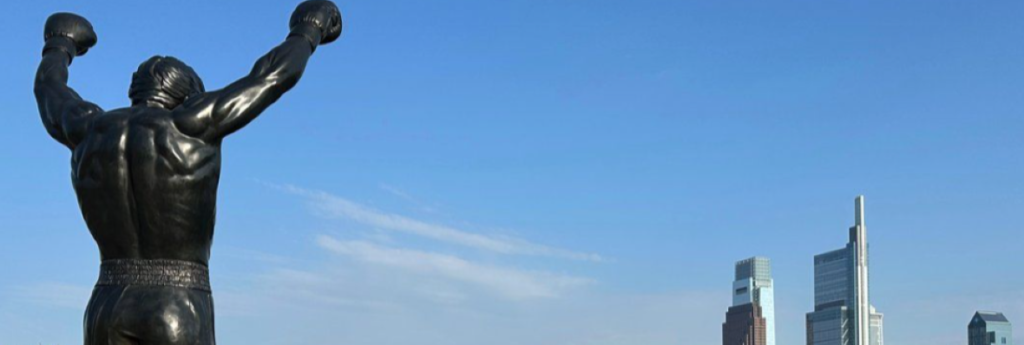
Every day, visitors from around the world make their way to the steps of the Philadelphia Museum of Art – not necessarily for the galleries inside, but for a statue of a fictional boxer from South Philadelphia. The bronze figure of Rocky Balboa – arms raised in victory, clad in boxing trunks and boots – has become a point of pilgrimage for people around the world.
For decades, the museum kept an uncomfortable distance from this kind of devotion. Now, 50 years on from the release of the iconic film, it is embracing it – and inviting Rocky in. A new exhibition at the venue examines how a fictional fighter became a real-world symbol, placing the statue within the sweep of art history and Philadelphia’s identity.
“Rising Up: Rocky and the Making of Monuments” spans more than 2,000 years of boxing imagery, tracing a thread of human struggle that Louis Marchesano, the museum’s deputy director of curatorial affairs and conservation, said helps explain Rocky’s enduring pull.
“The common theme that runs throughout 2,000 years of boxing imagery is that people respond to the body under struggle, a conflict in much the same way today as they did 2,500 years ago,” Marchesano said. “It’s not simply about watching two people beat each other up – it’s about endurance, internal fortitude and internal struggle.”
When the bronze statue was left on the steps after filming the “Rocky” movies, the museum fought to have it removed. It was eventually relocated to South Philadelphia before returning to the bottom of the steps in 2006. It was welcomed back, but never fully embraced. The city owns the spot where the statue sits – not the museum.
“The museum has had – and I hate to say this, no pun intended – a rocky relationship with the statue,” Marchesano said. “It took us decades to come to terms with it,” he added. “But I’m glad that we did.”
According to the Philadelphia Visitor Center, about 4 million people visit the steps each year – rivaling the nearby Liberty Bell in annual foot traffic.
One gallery places Rocky in the global boxing fever of the 1970s, featuring works by Keith Haring, Jean-Michel Basquiat and Andy Warhol – all created during a time when boxing had the world’s attention.
“In the 1970s, we knew minute by minute who the heavyweight champion of the world was,” Marchesano said. “The artists in this gallery are responding to that global frenzy. Sylvester Stallone, in ‘Rocky,’ was doing the same – thinking about internal and external struggle.”
Another gallery turns to Philadelphia itself, presenting photographs of the Blue Horizon boxing gym and a section on Joe Frazier, whose real-life story at least partially inspired Rocky.
“Without Joe Frazier, Rocky doesn’t exist,” Marchesano said.
When the exhibition closes in August, the statue inside will move to a permanent home at the top of the museum’s steps – a place it has never officially held. The statue currently outside remains on loan from Stallone.
Rocky’s longtime spot at the bottom of the steps won’t be empty – a statue of Frazier will replace it.
Other Philadelphia landmarks & experiences
The obvious ones are the Liberty Bell, Independence Hall, Elfreth’s Alley, the Franklin Post Office & Museum.
- The new Ministry of Aweis an immersive, interactive, multisensory art experience housed in a transformed 19th-century bank in Old City. This six-storey project, created by internationally renowned artist Meg Saligman with more than 100 collaborators, features immersive installations, performance art, interactive sculpture, and layered soundscapes that invite visitors to explore art in unexpected ways.
- Through July 4, ArtPhillypresents “What Now: 2026,” a major city-wide, multidisciplinary arts festival celebrating Philadelphia’s role in American culture and creativity during the nation’s 250th anniversary. Spanning iconic venues across the city, the festival will feature more than 30 original commissions and projects in music, visual art, theatre, dance, and other artistic Expression, highlighting Philadelphia’s vibrant creative community.
- Having opened in September 2025, Calder Gardens is the newest jewel on Philadelphia’s Museum Mile. Dedicated to Alexander “Sandy” Calder, the natural light-filled galleries and native gardens house a rotating selection of masterworks, including his iconic mobiles and sculptures. The space serves as a sanctuary for contemplation and community programs throughout the changing seasons.
- Bringing a new entertainment experience to Philadelphia, F1 Arcadecombines cutting-edge Formula 1 racing simulators with food and drink in a high-energy social setting. Designed for both casual visitors and competitive racers, the venue allows guests to experience the thrill of F1 racing through immersive simulations while enjoying a lively atmosphere in the heart of the city.
Food
Philadelphia is known for its food – everything from cheesesteaks to soft pretzels to water ice; the former, which originated in Philadelphia in the early 1900s, is widely considered the city’s signature food – chopped steak, onions, cheese (often provolone) on a seeded roll. Pat’s King of Steaks and Geno’s Steaks are tourist favourites – as is the Bradley Cooper-approved Angelo’s and Skinny Joey’s Cheesesteaks. Better still, visitors can take “Make Your Own Cheesesteak” tour.
Sports
A year-round sport town, which major leagues spanning every major sport, Philly this summer is also a World Cup city, offering, beyond the games, a fan festival that is free and open to the public for all 39 days of the tournament. The festival is being held at Lemon Hill in East Fairmount Park and will include a vendor village and other cultural programs.
Philadelphia will host the 96th Major League Baseball All-Star Game on July 14 at Citizens Bank Park.
If you enjoyed or found this story useful, we’d appreciate if you would forward it to a colleague or friend who may also enjoy it. If, on the other hand, a friend shared it with you, welcome! You can get all the latest travel news and reviews from Travel Industry by simply clicking HERE.