


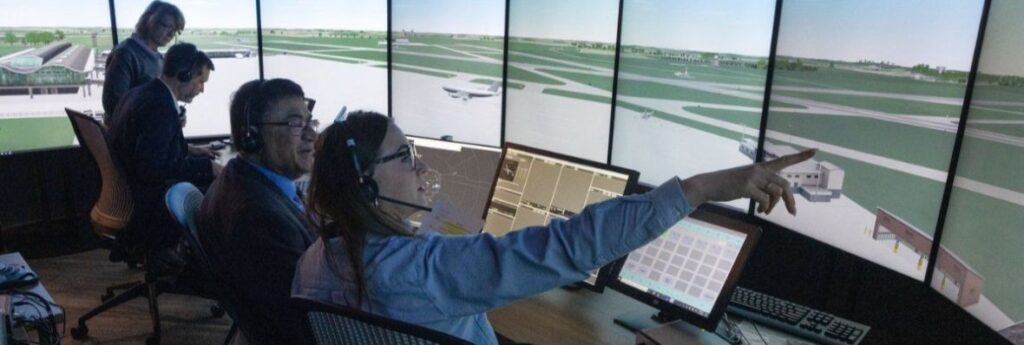
Canada is short an estimated 200 air traffic controllers, but and is working on building its capacity, says Nav Canada, the privately run, non-profit corporation that is responsible for training and employing the specialized workers who play a critical role in the safety of Canada’s air travel system.
The role of air traffic controllers in the U.S. has been highlighted in discussions following the crash of an Air Canada jet on a runway at the LaGuardia airport in New York in March, though the National Transportation Safety Board in the U.S. has warned that no conclusions can be drawn yet about the causes of the crash.
Responding to claims that the shortfall of air traffic controllers is much higher, Nav Canada spokesperson Gabriel Bourget said, “In the interest of putting this to rest: Nav Canada’s current estimated shortfall against our staffing targets is approximately 200 air traffic controllers.
“The International Federation of Air Traffic Controllers estimates the U.S., which handles roughly 10 times Canada’s traffic, is short 3,000 to 4,000 controllers. A Canadian shortfall of 1,500 would imply a proportionally larger workforce gap than that of the United States, which does not reflect the reality in any way,” he added.
John Gradek, a faculty lecturer with McGill University’s aviation management program says air traffic controllers are highly trained with a “special skill set.”
“We know three dimensions. The trick about controllers is they need a fourth dimension, and they have to understand the fourth dimension being time,” Gradek said. “(If) I make a decision to move an aircraft up 1,000 feet or down 1,000 feet, or turn left or turn right. I’m making that decision because I want this airplane to be in this location at this time and in the future. So that’s a special skill set. Not everybody has it.”
Bourget says Nav Canada is working to address air traffic controller staffing through a multi-year strategy.
“Canadians and travellers can be reassured, we are in solution mode: focused on strengthening service resiliency, supporting our people, working constructively with industry partners while upholding the highest standards of safety they rightly expect,” he wrote in an e-mail.
He said that since 2023, the agency has licensed more than 600 air traffic professionals, including more than 300 controllers. In 2025, the agency received 49,000 applicants and hired close to 500 students, Bourget said.
The term “air traffic controllers” covers area control centre controllers, or ACC controllers, who issue instructions to pilots and ensure that aircraft are kept a safe distance apart while airborne.
It also includes tower controllers, who give pilots clearances and instructions to maintain separation during takeoff and landing.
The total training time ranges from 10 to 18 months for tower controllers, and from 20 to 27 months for ACC controllers.
Gradek said Canada’s training and air navigation systems are “second to none” in the world, but noted some graduates are still taking jobs abroad.
Nav Canada wouldn’t say exactly how many of the 300 air traffic controllers it has licensed since 2023 took up jobs in Canada. It would only say that the “vast majority” did so.
“Australia is hiring controllers like crazy and New Zealand is hiring, the U.S. is hiring, the U.K. is hiring. So, it’s not … as if this is a Canadian-only job,” Gradek said.
Nav Canada says the salary range for a Canadian controller can top $200,000 a year after they’re fully certified, while controllers in training earn about $60,000. The median pay for American controllers in 2024 was $US144,580, according to the U.S. Bureau of Labor Statistics.
Transport Minister Steven MacKinnon says he is working with Nav Canada to find solutions to the shortage of controllers.
“I’ve asked Nav Canada to continue to come up with solutions for recruitment so that we can reduce the undue reliance we have on a smaller number of air traffic controllers than we would wish to have,” MacKinnon told reporters before Nav Canada publicly confirmed the shortfall of 200 air traffic controllers.
He added that Canadians can have a high degree of confidence in the security of Canada’s transport systems, including aviation.
“I do want to be very reassuring that we take every precautionary measure and make sure that Canada continues to perform at the highest levels of security,” he told reporters on his way into a cabinet meeting in Ottawa.
“The Americans have very high standards, and we have a very collaborative relationship with the U.S., and I know they’ll be as eager as we to find the answers.”
If you enjoyed or found this story useful, we’d appreciate if you would forward it to a colleague or friend who may also enjoy it. If, on the other hand, a friend shared it with you, welcome! You can get all the latest travel news and reviews from Travel Industry by simply clicking HERE.