



By Anita Draycott/ When the International Association of Golf Tour Operators awarded Wales the “undiscovered Golf Destination of the Year in 2003,” that kudo, plus the Ryder Cup at Celtic Manor in 2010, put the country on the global golf map. Wales hosted The Senior open in 2014, 2017 and 2023. This year the AIG Woman’s Open comes to Royal Porthcawl (July 30 to Aug. 3).
But despite its newfound limelight, the game here remains “golf as it should be”– the catchy slogan the Wales Tourist Board uses to promote the sport. What does that mean? A warm welcome in unstuffy clubhouses, green fees at a fraction of what you’d pay elsewhere in the U.K., and some of the finest links on the planet.
Bring on the gladiators
From Heathrow airport, my group headed the rental car west along the M4. We knew we’d arrived in Wales when the road signs became bilingual and the lengthy Welsh words indecipherable. We checked into Celtic Manor looming at the top of a hill, its Welsh flag beckoning.
Back in the first century AD, the Romans built an amphitheatre at Isca their fortress in west Britain. It was a place for entertainment, sport and gladiatorial combat. Two thousand years later and approximately a driver and a five-iron away, a new amphitheatre, the Twenty Ten course at Celtic Manor, became the venue for the 2010 Ryder Cup spectacle. It’s the first course ever to be purpose-built for a Ryder Cup.
Today the sprawling Celtic Manor Resort includes the five-star hotel, hunting lodge cottages, spa and health club, five restaurants, golf academy and three 18-hole golf courses – the Roman Road, the Twenty Ten and Montgomerie (which I did not play).
The par-70 Roman Road overlooks the Severn Estuary with sweeping views across to English counties of Somerset and Devon. Designed by Robert Trent Jones Senior, it’s named after the Via Julia built by the Romans.
The Twenty Ten course is not for the faint of heart. Measuring a whopping 7,493 yards from the tips, there’s water in play on about nine holes and plenty of bunkers on this par-71 challenge.
The 18th, a 575-yard par-five is a fitting finale. A good drive allows the possibility of reaching the green in two provided that a long approach shot across water reaches the elevated green that is defended by a pair of sizable bunkers eager to snare anything too ambitious.
Royal Porthcawl
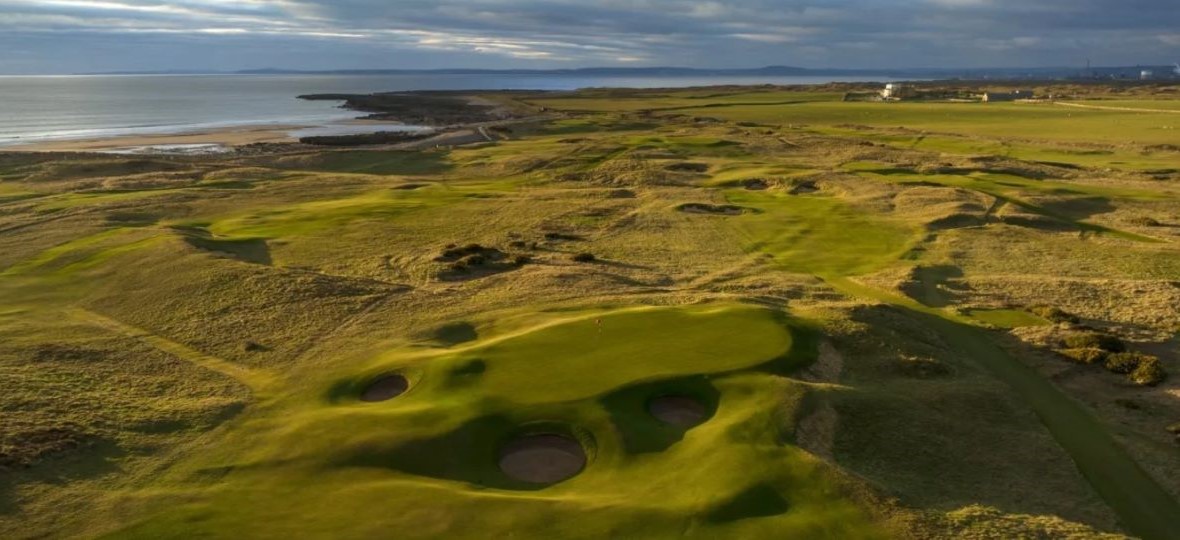
The courses at Celtic Manor are parkland-style, but now we were about to tackle some true links. For pampered North American golfers, the first encounter with a real links course may come as a bit of a shock. Forget about wall-to-wall fairways, copious yardage markers and cart girls. Buggies, as electric carts are called over here, are few and far between; links courses were meant to be walked. Count on quirky bounces. Expect to lose plenty of balls in the rough and taste the salt in the invigorating air.
Links courses were created mainly by Mother Nature, carved through dunes linking land and sea. This is golf at its purest.
Often hailed as Wales’ finest, Royal Porthcawl’s first three holes play so close to the Bristol Channel you can taste the salt. The epitome of a classic coastal links course, there’s a continuous view of the sea with twists and turns that reward precision over power. Long marram grass and gorse are ever present and waiting to snag an errant shot. Wind is a constant factor. On certain days when the wind howls and a mist descends, you may encounter the ghost of the Maid of Sker on the 17th.
Founded in 1891 and given Royal status in 1909 by King Edward VII, Porthcawl has the distinction of being only one of 66 in the world to have this regal distinction. The club was the last in Wales to allow women to be members. It’s fitting that in 2025 it is hosting the AIG Women’s Open.
Golfers wishing to play here must produce handicap certificates (maximum 20 for men; 30 for women).
Royal St. David’s
Leaving the southern coast of Wales, we headed up the northwest coast into spectacularly scenic Snowdonia National Park, known for its rolling hills, deep valleys and patchwork fields in myriad shades of green.
At Royal St. David’s Golf Club, we parked in the lot and schlepped our bags across the railway tracks to the clubhouse. Founded in 1894, the course lies in the stern shadow of the towering Harlech Castle.
What you see is what you get at Royal St. David’s. There are no hidden bunkers, nor blind shots. A new irrigation system has given the fairways better definition to help golfers with their aim. Only twice do successive fairways proceed in the same direction so the wind invariably becomes a major factor. The last five holes form a loop through the imposing dunes for one of golf’s finest finishes.
Nefyn
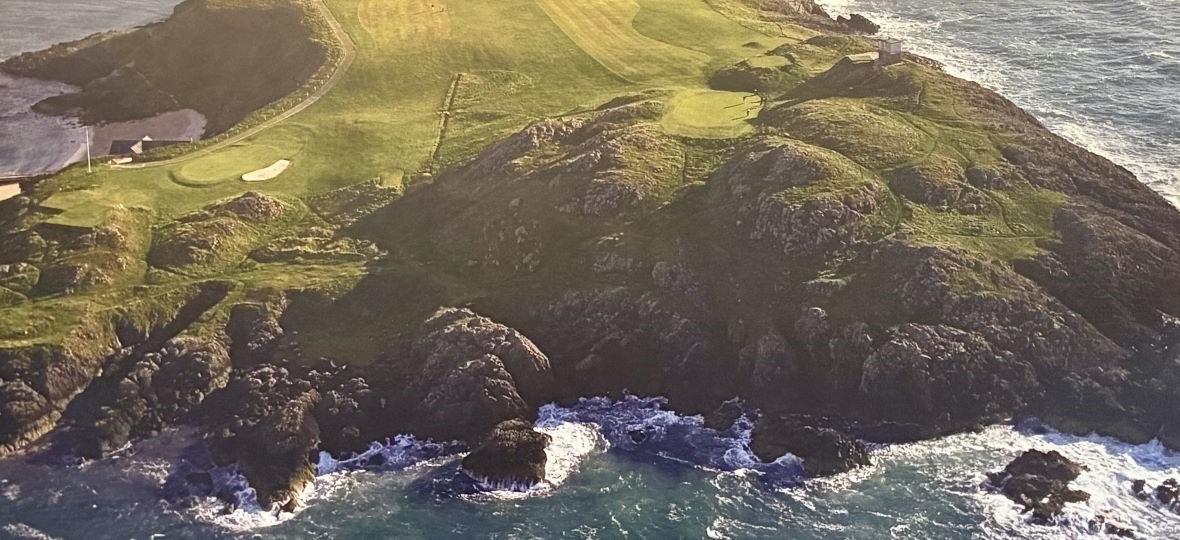
Nefyn Golf Club on the north coast was next on our hit list. Dubbed the Pebble Beach of Wales, Nefyn is a twenty-seven-hole track: the Championship 18 and the 9-hole Point. All bookings are made for the 18-hole course; there is an option to play the Point 9 holes as a free extra if available on the day of play. For sheer cliff-hanging drama try to play the Point. It clings to the top of a narrow peninsula. One golf writer remarked that it was “like playing on the deck of an aircraft carrier.”
You won’t likely forget the par-three 5th. You climb the stairs of a stone tower and tee off from an artificial matt. Perhaps no other hole in the world confronts the golfer with the distractions on number seven with its blind drive, blind second shot, public thoroughfare populated by hikers and a crater-sized pit. Before teeing off on number 7, follow a footpath down to the Ty Coch Pub, located on the beach at Porthdinllaen, for a quick pint and a crab roll. It’s a delightful Nefyn tradition.
If this article was shared with you by a friend or colleague, you may enjoy receiving your own copy of Travel Industry Today with the latest travel news and reviews each weekday morning. It’s absolutely free – just CLICK HERE.