


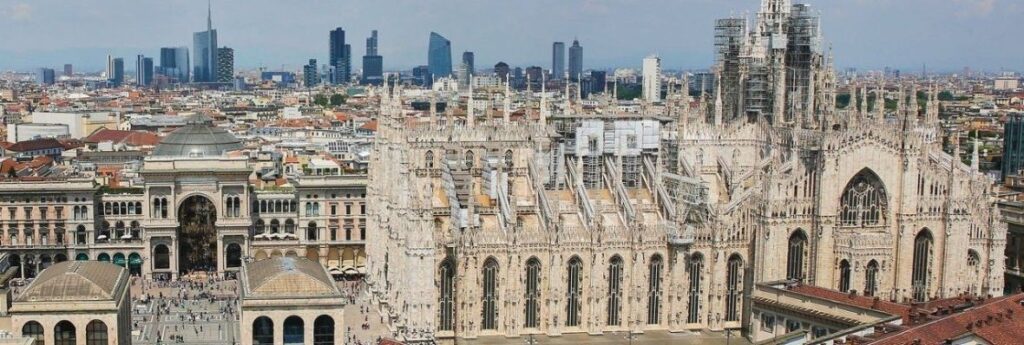
Milan has added the title of Olympic city to its long-held monikers as Italy’s fashion and finance capital, a legacy that crowns two decades of growth that reshaped the skyline and boosted investment, tourism and cultural life.
The legacy of the Milan Cortina Winter Games is both physical, in new facilities and infrastructure, and intangible, burnishing Milan’s global image. It’s the second major event to leave a lasting mark on the city, after the Expo 2015 world’s fair brought new investment, tourists and talent.
“Milan is more and more creating a distinctive brand able to attract an international audience,’’ said Dino Ruta, who is heading up a Bocconi University study on the Olympics’ economic impact for the International Olympic Committee, expected later this year.
The physical legacy of the Milan Cortina Olympics is relatively slight, by design. The Games were spread out over seven city, valley and mountain venues hundreds of kilometers apart to leverage existing facilities, saving on new construction.
Milan inherits the brand new Santgiulia arena, which hosted Olympic hockey and will be used for concerts, exhibition and sporting events, while the athletes’ Olympic Village will be turned into housing for 1,700 students, badly needed in a city with 10 universities and an affordable housing crisis.
Preliminary data gathered for the Bocconi study shows that about 4 billion euros ($4.7 billion) were invested in the Games, including for new and upgraded sports facilities, transportation investments on roads, metro accessibility, railways and ski lifts, energy costs and the administration of the Games, Ruta said.
In Milan, the Games cost 735 million euros ($867 million) to host 90 indoor ice events and the opening ceremony at San Siro, while visitors were on course to spend around 1 billion euros ($1.2 billion), according to a Feb. 16 report by the Assolombarda business association. The Olympics are forecast to boost 2026 economic growth in Milan by 0.6 percentage points to 1.7%, accelerating industrial output in the entire region, the association said during the Games.
Two-decade transformation
Milan’s transformation from a provincial city known primarily as an industrial and business centre began in the early 2000s, when a wave of redevelopment projects started reshaping its skyline.
The CityLife district emerged around three skyscrapers designed by Zaha Hadid Architects, Daniel Libeskind and Arata Isozaki, while the Porta Nuova development introduced the flagship UniCredit Tower, the city’s tallest building at 218 metres, completed in 2012.
Much of this building boom coincided with Expo 2015, which drew 22 million visitors over six months and repositioned Milan as an international tourist destination.
Tourism has grown steadily since, rising 6.5% to 9.6 million visitors in 2025, from just over 9 million a year earlier.
“Expo was not an isolated success,” said Fiorenza Lipparini, director general of Milano & Partners – YesMilano, the city’s promotion agency. “It marked a systematic shift.”
Beyond tourism, Expo triggered a 3-billion-euro investment to transform the former Expo site into MIND, a science and technology hub. Since then, the number of five-star hotels has tripled.
Milan has also added two subway lines and opened a dozen new museums, including Fondazione Prada, MUDEC and Pirelli HangarBicocca.
Post-Olympics
The Olympic Village has speeded up redevelopment in the southern Porta Romana railyard, next to one of Milan’s largest former industrial sites.
The 20-hectare project will deliver 100,000 sq. m. of housing – about half social housing under city rules adopted in 2019 – along with parks and public space covering roughly half the site.
The area sits across from Fondazione Prada, one of the first projects to catalyze the regeneration of the former industrial Symbiosis district, emerging as a fashion hub with headquarters for Bottega Veneta and Moncler. A new headquarters for Diesel-owner OTB is also under construction nearby.
“Major events can open the interest of the world to the city,” said Luca Mangia, general manager of COIMA, the developer behind the Porta Romana and Porta Nuova projects. “We saw that with Expo 2015 and we hope it will happen again with the Olympic Games.”
“In this case, the Games allowed us to accelerate construction of the Olympic Village and move forward more quickly with regeneration of the area,” Mangia said.
If you enjoyed or found this story useful, we’d appreciate if you would forward it to a colleague or friend who may also enjoy it. If, on the other hand, a friend shared it with you, welcome! You can get all the latest travel news and reviews from Travel Industry by simply clicking HERE.