


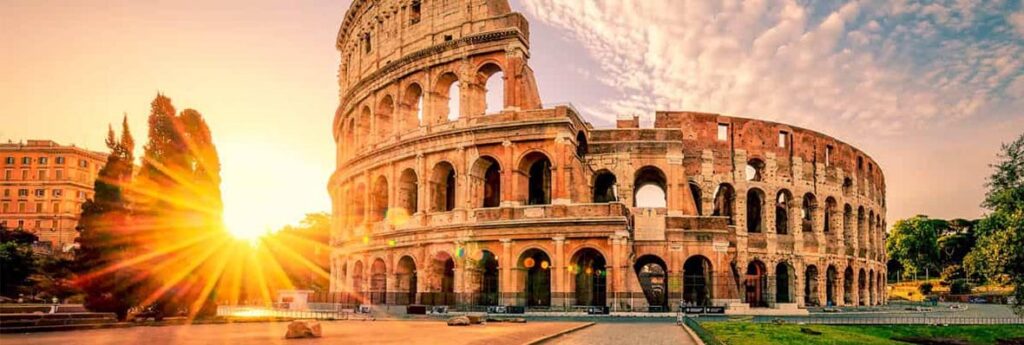
Rome’s Colosseum has a bright new look following a restoration using the same travertine marble of ancient Rome to recreate parts of columns from 2,000 years ago. Thousands of Romans once flocked to this arena to watch gladiators battle each other and wild animals. The structure still captures the public’s imagination; it is Italy’s most popular tourist destination, with 9 million visitors in 2025 alone.
The project focused on a semicircular piazza outside the arena, where Roman spectators crowded under two arcades comprised of marble columns stretching up to 50 metre high. People stood in these arcades as they waited to pass through the entrances and take their seats.
Those arches are long gone, collapsing over the centuries from earthquakes and unstable ground. But now, tourists will be able to sit on large travertine marble slabs where the columns once stood and read reproductions of the Roman numerals that indicated seat sections.
“These blocks of travertine marble are placed, located exactly where the pillars, the original pillars were based,” said Italian architect Stefano Boeri, who designed the piazza. “The idea we had was to give back to the public the perception of the proportion of the arcades and the proportion of the vaults of the arches that were used to enter in the centre of the Colosseum.”
Over time, the outside area became filled with detritus, including pieces of ruins, and overgrown with weeds.
Restorers began by digging a metre to where the travertine paving stones once covered the entrance area. They discovered coins, statues, animal bones and a gold ring. Deeper down is the secret underground passageway where Emperor Commodus used to enter the Colosseum while avoiding the hoi-polloi, and which was opened to the public last year.
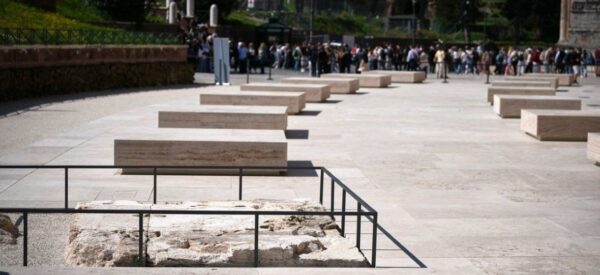
Restorers sourced the new slabs of travertine from the same quarries where the ancient Romans retrieved theirs – and that today are used build a new generation of religious buildings, banks, museums, government buildings and private homes.
“From the beginning we understood only one thing and that was that we wanted to be involved,” said Fabrizio Mariotti, head of the Mariotti Carlo stonecutting firm that has been carving travertine to order for four generations in Tivoli.
“For a family like ours that has been working with travertine for four generations, working at the Colosseum, which is the symbol not only of Rome but also of this material, is so important.”
Earlier this year, the city of Rome opened two new subway stations, one deep beneath the Colosseum completing a multi-billion euro metro project. The restoration of the Colosseum’s perimeter was done using compensatory funds from the metro, project officials said.
If you enjoyed or found this story useful, we’d appreciate if you would forward it to a colleague or friend who may also enjoy it. If, on the other hand, a friend shared it with you, welcome! You can get all the latest travel news and reviews from Travel Industry by simply clicking HERE.