



It’s complicated. Air travel up, car travel down. And vice-versa. Big drops, steady gains. Anecdotal evidence, statistical counterpoint. So, where exactly does Canadian travel to the U.S. stand – where has it been (down, we know, but how much) and where is it headed? Statistics Canada tells all in a “year in review” report, which we present here.
Compiled by the bureau’s Laura Presley of the Tourism Statistics Program and Carter McCormack of the Economic and Social Analysis and Modelling Division, the analysis begins in 2023 and also examines the situation’s effect on domestic and overseas travel by Canadians.
Here it is in full:
“The United States has long been Canada’s primary international travel destination, partly because of its proximity and warmer climate. In 2024, Canadian-resident return border crossings from the United States totalled 39 million, representing three-quarters of all Canadian-resident return border crossings from abroad.
Following the change in the U.S. administration in early 2025 and the implementation of America First policies, Canadian travel sentiment shifted abruptly. By the end of 2025, return border crossings from the United States accounted for two-thirds of all Canadian resident border crossings from abroad.
Travel to the United States yet to recover from the pullback in 2025
Beginning in early 2025, Canadian-resident return border crossings by automobile contracted sharply, while returns by air declined throughout the year, reflecting in part the fact it is relatively easier to change automobile travel plans than air travel plans.
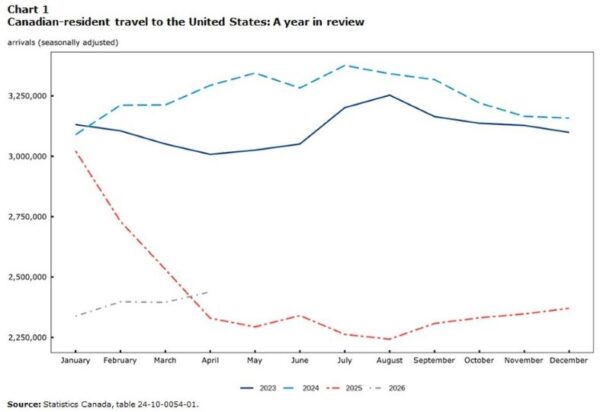
Total Canadian-resident return border crossings from the United States dropped in 2025, down one-quarter (-25.4%) from 2024. The magnitude of the pullback grew as the year progressed, bottoming out in July, with border crossing volumes nearly one-third below those reported 12 months earlier. Return crossings then stabilized in late 2025 to about one-quarter below 2024 levels.
Excluding the COVID-19 pandemic period, the resulting 11-month streak of year-over-year declines was the deepest and most sustained on record for border crossings from the United States. Since 1972, when digital recordkeeping began for the Frontier Counts program, year-over-year declines of more than 30% have been recorded for only one other occasion, in September 2001, following the Sept. 11, terrorist attacks on the World Trade Center in New York City.
In early 2026, total return border crossings from the United States remained at levels similar to those reported in late 2025 (Chart 1), signalling a persistent shift away from the United States by Canadian residents in their travel preferences.
Data from the National Travel Survey (NTS) show that the pullback in stateside travel (-23.5%, or -7.1 million visits, compared with 2024) was almost entirely offset by the combination of domestic and overseas travel. Compared with 2024, domestic visits rose 1.5% (+5.0 million visits), accounting for over 90% of all Canadian-resident visits at home and abroad.
Overseas destinations were the second-largest beneficiary, with total visits for the year rising by 1.3 million (+10.2%). Travel to European and Asian continents experienced the biggest increase among overseas options – visits to Europe were up 13.6% (+579,000), while visits to Asia rose 16.7% (+387,000).
Leisure-related travel is the driving force for both visits and expenditures abroad
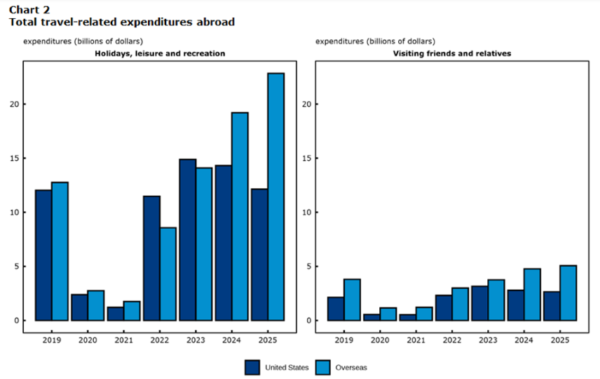
The majority (58.4% in 2025) of Canadian-resident travel abroad is taken for holiday, leisure and recreation purposes. In 2025, Canadians shifted outbound leisure-related travel plans away from the United States (-21.5%, or -3.2 million visits) in favour of overseas options (+12.2%, or +1.1 million visits). United States visits to see friends and relatives (family related) were less prone to destination substitution and declined by 9.0% (-536,000 visits) in 2025.
Canadians travelling abroad whose main trip purpose was leisure related spent 4.5 times more than those whose main trip purpose was family related (Chart 2). This reflects leisure travellers’ tendency to spend more on accommodation, food and beverages, and transportation than those travelling to visit family and friends in 2025.
Travel spending on visits to the United States declined by $3.3 billion to total $18.8 billion in 2025. Lower spending on leisure-related visits, which fell by $2.2 billion to $12.1 billion, was the driving force behind this decline. In contrast, spending on leisure-related visits overseas grew by $3.6 billion in 2025 to $22.8 billion, accounting for just under half of overall expenditures abroad.
For domestic travel, spending on trips whose main purpose was leisure related was 1.7 times higher than spending on trips where the main purpose was family related. Accordingly, the growth in domestic expenditures in 2025, which rose 8.7% to $81.3 billion, was driven by an 8.1% increase in spending on leisure-related travel.
Together, domestic and overseas visits almost entirely offset the decrease in visits to the United States
The data show that family-related travel to the United States has declined at a much slower pace than leisure-related travel. Leisure-related travel to destinations other than the United States was a driving force behind the $50 billion in tourism spending outside Canada in 2025.
Early data for 2026 suggest that the steep decline in stateside border crossings is persisting.
If you enjoyed or found this story useful, we’d appreciate if you would forward it to a colleague or friend who may also enjoy it. If, on the other hand, a friend shared it with you, welcome! You can get all the latest travel news and reviews from Travel Industry by simply clicking HERE.