


As spring unfolds across Japan, the nation’s most beloved seasonal spectacle – cherry blossoms (sakura) – progresses northward from the southern islands toward the country’s cooler regions. While the earliest petals have already appeared in parts of Kyushu and Shikoku, the peak of blooming is advancing steadily through central and northern Japan, with many regions just entering their most anticipated viewing period.
Cherry blossoms bloom for only seven to 10 days, making their beauty fleeting and deeply cherished. Rather than a single moment, the season unfolds as a moving celebration from mid-March through early May, offering travellers the opportunity to follow the blossoms as they advance throughout Japan’s chain of islands.
Where and when to experience the cherry blossoms
As the cherry blossom front moves north, several regions are approaching or entering peak bloom:
Hokuriku Shinetsu Region (late March to mid April):
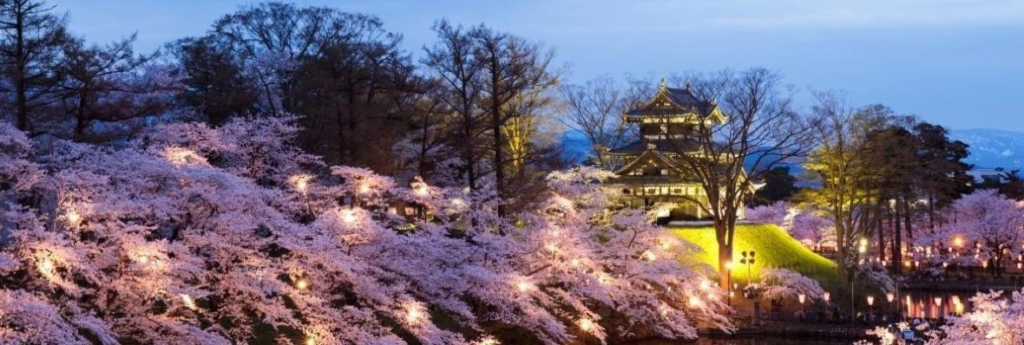
- Niigata: Takada Castle Park Cherry Blossom Festival is one of Joetsu City’s historic signature events, and this year marks its 101st anniversary. Held annually from late April to early May, the celebration transforms the park into a sea of pale pink, beautifully illuminated by more than 3,000 paper lanterns. Their light shimmers across the castle moat, creating one of Japan’s most unforgettable nighttime scenes.
- Nagano: Shinshu Zenkoji Temple stores one of the first Buddhist statues ever brought into Japan when Buddhism was first introduced in the 6th century. This historic temple is surrounded by a mix of beautiful cherry and weeping cherry trees, making it especially stunning in the springtime.
Tohoku Region (mid to late April):
- Akita: Kakunodate, the samurai town known as the “Little Kyoto of Michinoku,” hosts its Cherry Blossom Festival from April 15 to May 5. Samurai Residence Street becomes especially enchanting beneath cascading blossoms. After sunset, soft lights and drifting petals create a dreamy, unforgettable scene for visitors while they sample the area’s street food and drinks.
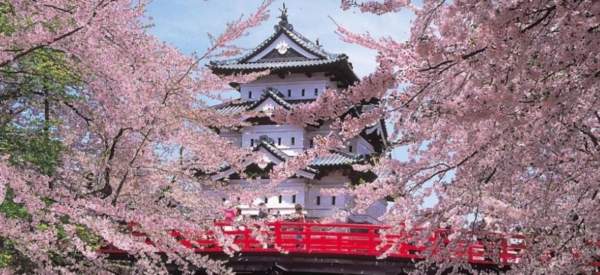
- Aomori: Hirosaki Castle Park is home to the oldest Somei-Yoshino tree and more than 2,500 cherry trees surrounding the castle. With blossom tunnels, petal-filled moats, picnic spots, rowing boats and evening illuminations, it feels like several great cherry blossom spots combined into one.
Tohoku Region (mid to late April):
- Akita: Kakunodate, the samurai town known as the “Little Kyoto of Michinoku,” hosts its Cherry Blossom Festival from April 15 to May 5. Samurai Residence Street becomes especially enchanting beneath cascading blossoms, taking visitors back to the Edo era. After sunset, soft lights and drifting petals create a dreamy, unforgettable scene for visitors while they sample the area’s street food and drinks.
- Aomori: Hirosaki Castle Park is home to the oldest Somei-Yoshino tree and more than 2,500 cherry trees surrounding the castle. With blossom tunnels, petal-filled moats, picnic spots, rowing boats and evening illuminations, it feels like several great cherry blossom spots combined into one.
Hokkaido (late April to early May):
- Hakodate: Goryokaku Tower is one of Hakodate’s signature attractions, offering panoramic views of the star-shaped Goryokaku Park below. In spring, more than 1,600 cherry trees line the moat around the fort, turning the entire citadel a soft pink. As petals drift across the water, the scene becomes especially beautiful – best admired from above.
Tasting the Sakura Season
Sakura season is not only seen, but to be savoured. The blossoms’ subtle salty-sour flavor – derived from flowers preserved in salt or plum vinegar – appears in seasonal specialties. Among them are the Sakura Mochi, a pink rice confection wrapped in a salted cherry leaf first popularized in Edo (modern-day Tokyo); Sakurayu (cherry blossom tea), traditionally served at celebratory occasions; and Sakura Ebi, the pink shrimp harvested in Shizuoka’s Suruga Bay, whose delicate hue mirrors the blossoms themselves.
Horticultural Expo
Japan’s appreciation of the four seasons is deeply woven into its cultural identity, and sakura has long symbolized renewal, transience and harmony with nature. This connection between people and the natural world continues to shape the country’s outlook. Next year, Yokohama will host Green x Expo 2027 (International Horticultural Expo 2027), a global gathering focused on sustainability, innovation and coexistence with nature, taking place from March 19 to Sept. 27.
If you enjoyed or found this story useful, we’d appreciate if you would forward it to a colleague or friend who may also enjoy it. If, on the other hand, a friend shared it with you, welcome! You can get all the latest travel news and reviews from Travel Industry by simply clicking HERE.