


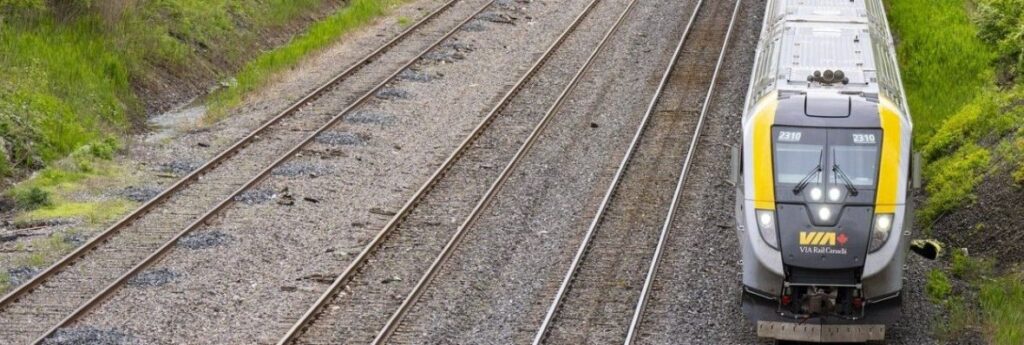
The first segment of the federal government’s proposed high-speed rail project will connect Montreal and Ottawa, acting as a test case for a multibillion-dollar infrastructure project intended to transform rail travel in Canada’s most densely populated region.
Transport Minister Steven MacKinnon said Friday that connecting Ontario and Quebec was the “logical” first step for the planned 1,000-kilometre rail network, which would see trains travelling between Toronto and Quebec City at speeds of up to 300 kilometres per hour. Construction is expected to begin in 2029.
“This segment represents a unique opportunity to connect two provinces and quickly generate benefits for travellers, communities and the economy,” MacKinnon told reporters at a press conference in Gatineau, Que.
The high-speed rail project was first announced by then-prime minister Justin Trudeau in February. If completed, it could take passengers from Toronto to Montreal on dedicated tracks in less than three hours. The trip from Ottawa to Montreal is estimated to take slightly less than an hour.
Prime Minister Mark Carney announced in September that the government’s new major projects office would speed up engineering and regulatory work on the railway to get construction underway within four years.
MacKinnon said the roughly 200-kilometre stretch between Montreal and Ottawa is “relatively short and straight,” and will allow teams in both provinces to start building the expertise needed for the rest of the project. It would include a stop in Laval, Que., an off-island suburb north of Montreal.
The exact route of the rail line has not yet been determined.
Ultimately, the network is expected to extend west to Toronto, through Peterborough, Ont., and east to Quebec City, through Trois-Rivières, Que. Alto CEO Martin Imbleau said work will begin on those segments during construction of the first leg.
Paul Langan, founder of advocacy group High-Speed Rail Canada, said it makes sense to start with the Ottawa-Montreal segment, which he said is the easiest part of the route. “This is a very smart decision to get this going and have a tangible result within a decade,” he said.
Getting the first leg built would be a big win in a country that still sees high-speed rail as “futuristic,” he said. “I am optimistic, for the first time in a long time, that it’s going to happen.”
If this article was shared with you by a friend or colleague, you may enjoy receiving your own copy of Travel Industry Today with the latest travel news and reviews each weekday morning. It’s absolutely free – just CLICK HERE.