


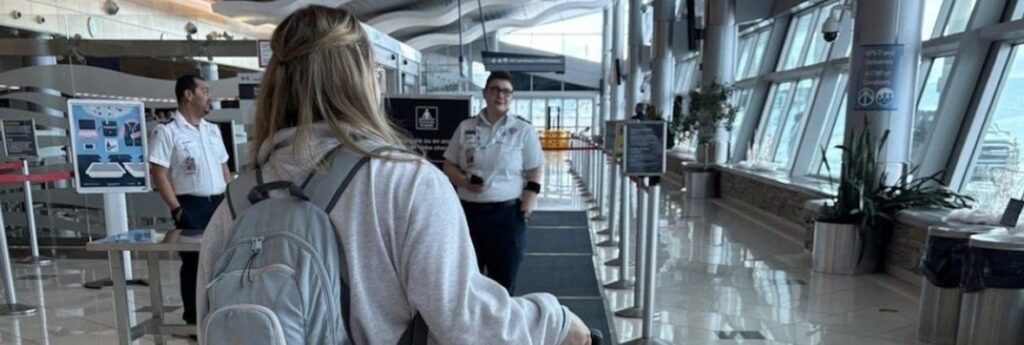
By Sean Ridgeley/ Kaylee Clarke was making her way back to school in Truro, N.S. from Newfoundland after the holidays when it quickly became clear it was not going to be a straightforward trip. Ultimately, a journey that should have taken a few hours took a few days, hampered by airline delays and reroutes, damaged luggage, and 14 hours just to get back where she started.
The original plan was to fly from St. John’s to Moncton on Jan. 2, where her boyfriend – then in PEI – would pick her up on the way back to Truro. The flight – booked months prior on Expedia – was complicated from the start, going through Deer Lake, Happy Valley-Goose Bay, Wabush, and Mont Joli.
“Obviously not ideal, but it was the only option available,” she wrote in a Facebook post, later clarifying to the local Telegram newspaper that she had to be home at a specific date for her classes – the Newfoundland native studies veterinary technology at Dalhousie University – which limited her choices.
The initial flight was delayed due to “crew issues” – “I heard them say over the walkie-talkie they needed tape to fix the overhead bins,” she said – which took an hour.
Once in Deer Lake, after being stopped for 45 minutes, passengers were deplaned due to conditions in Goose Bay and told they would skip Goose Bay and go to Wabush.
Clarke was told she would likely miss her connecting flight from Wabush to Moncton, but felt she had to try, because if not, her trip wouldn’t be covered. The flight to Wabush was delayed two hours, and she did miss her connecting flight, and was told nothing else was available.
Her original flight was with PAL, which has a partnership with Air Canada, through which the trip was booked, but she was told there is no PAL service desk in Wabush.
With two hours of sleep, no food – Wabush airport only has vending machines, which weren’t working – and minimal cell service, she was feeling flustered.
Clarke’s mother, back in Bell Island, Nfld., eventually got in contact with her and informed her she wouldn’t be able to fly out until Jan. 6, but arranged a reroute to fly her back to St. John’s through Goose Bay, Deer Lake, and Gander.
After 14 hours of travel and 12 takeoffs and landings, she ended up back where she started.
With more help from her mother, she was booked for a hotel room in the city to get a couple of hours of sleep, as well as a flight on Jan. 3 at 5 a.m. But when she got to the desk, she was told there was no ticket booked, and because the PAL desk doesn’t open until 7 a.m., she was stuck for two hours waiting to speak with staff. When the staff arrived, she was told to talk to Air Canada, while Air Canada told her to speak with PAL.
Eventually, she was put on a direct flight to Halifax, thanks to an Air Canada staff member Clarke describes as “uplifting, supportive, and genuinely compassionate” – in contrast to her other experiences, where she says she was dismissed, forgotten, and made to feel she was being ridiculous for seeking basic support.

The flight was delayed; when she arrived in Halifax at approximately 5 p.m. the following day, she discovered her luggage was in Toronto.
“When I went up to the desk, I was told it would be delivered the next day, and I will be contacted for sure the next day about it,” she said. “Neither of (those things) happened.”
Her bag arrived on Jan. 5, but it was damaged.
“(It) was completely busted open and broken apart,” she wrote. “It was destroyed bit by bit throughout this ridiculous journey.”
Clarke filed a complaint regarding her flights with Air Canada and PAL on Jan. 4, and another regarding her bag on Jan. 5. She had yet to hear back.
Expedia has agreed to investigate after becoming familiar with the story.
CTA spokesperson Vincent Turgeon explained that airlines have specific obligations in these situations. “They must always keep passengers informed of their rights and the reason for a flight disruption,” he told The Telegram.
“It is important for airlines to give passengers the clearest and most up-to-date information available so that they can understand the situation, and then provide updates as more information comes to light or if the situation changes. Airlines must also help passengers complete their itineraries (re-booking them on other flights).
“If the reason for the disruption is within an airline’s control, it has additional obligations. These can include compensating passengers for inconveniencing them, and providing them with certain kinds of assistance, specifically food and drink, access to means of communication and overnight accommodation.
“In all situations, including those that would be deemed outside an airline’s control, the airline has to rebook the passenger on another flight if its original flight is delayed for three hours or more or is cancelled.”
“I was at the point where I wasn’t even just frustrated, I was genuinely scared because I had no idea what would happen next,” Clarke recalled. “I was in the middle of nowhere, freezing cold. When you’re a student, you don’t have money or flexibility to absorb all these days of chaos and changes. Even if you get reimbursed later on for anything, that doesn’t mean you’re going to have the money on the spot to pay for things.”
As for future trips, Clarke is concerned the episode will repeat, so she says she’ll be looking at simpler trips, and different airlines.
If you enjoyed or found this story useful, we’d appreciate if you would forward it to a colleague or friend who may also enjoy it. If, on the other hand, a friend shared it with you, welcome! You can get all the latest travel news and reviews from Travel Industry by simply clicking HERE.