


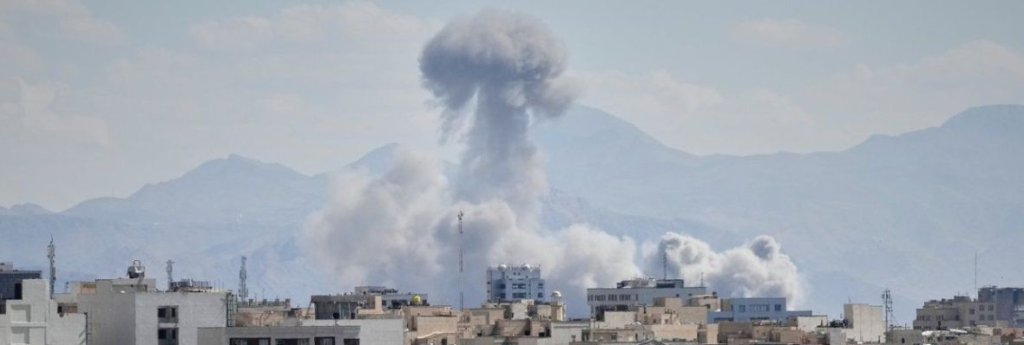
Hundreds of thousands of stranded travellers scrambled to make new connections and get through to airlines on jammed phone lines Sunday after the attack on Iran by the United States and Israel shut down much of the Middle East to air travel. Iran’s retaliatory strikes directly hit several airports in the region, which resulted in at least five deaths and more injuries.
Tourists and business travellers crowded hotels and airports, with no word on when many airports would reopen or when flights to and through the Middle East would resume. Some governments advised their stranded citizens to shelter in place.
Shutdown airports in Dubai, Abu Dhabi and Doha – including Dubai International Airport, one of the busiest in the world – are important hubs for travel between Europe, Africa and the West to Asia. All three were directly hit by strikes.
Confusion reigned for many travellers as they tried to get answers on online portals or through busy phone lines.
In Dubai, stranded travellers could hear fighter jets overhead and an explosion when the Fairmont Palm Hotel was hit by a missile strike. Many were unable to get updated flight information from tour operators or Dubai-based Emirates, which suspended all flights to and from Dubai until at least Monday afternoon.
Air Canada
Air Canada suspended all flights to and from Dubai (DXB) and Tel Aviv (TLV) and advised passengers on its website: “If you are in either of these regions, please do not head to the airport.”
It added that it closely monitoring the situation and will share information rebooking options and any next steps as soon as possible. Meanwhile, the carrier as removed re-booking penalties for clients space permitting.
Canada’s largest flight hub, Toronto’s Pearson Airport, is warning of delays and cancellations due to widespread airspace closures and are advising passengers to check their flight status before coming to the airport.
Flights cancelled, airports and airspaces still closed
Cirium, an aviation analytics firm, said it is hard to calculate the number of travellers stranded worldwide.
However, it estimated that at least 90,000 people alone change flights daily in the airports in Dubai, Doha or Abu Dhabi on just three airlines, Emirates, Qatar Airways and Etihad Airways.
Airspace or airports in Israel, Qatar, Syria, Iran, Iraq, Kuwait, Bahrain, Oman and the United Arab Emirates were closed, according to flight tracking sites and government agencies there.
More than 2,800 flights were cancelled Sunday to and from airports across the Middle East, including those that remained open in Saudi Arabia, Jordan and Egypt, according figures on flight tracking site FlightAware. International airports in London, Mumbai, Delhi, Bangkok, Istanbul, Sri Lanka and Paris each reported dozens of flights cancelled, as well.
Cancellations will extend beyond Sunday, at least.
Emirates suspended all flights to and from Dubai until at least Monday afternoon. Air India suspended all flights to and from the United Arab Emirates, Saudi Arabia, Israel and Qatar until Tuesday. Israeli airline EL AL said it was preparing to fly home Israelis stranded abroad once the airspace reopened and closed ticket sales for flights through March 21 to ensure stranded customers get priority.
Two airports in the United Arab Emirates reported strikes as the government there condemned what it called a “blatant attack involving Iranian ballistic missiles” on Saturday.
Officials at Dubai International Airport said four people were injured, while Zayed International Airport in Abu Dhabi said one person was killed and seven others were injured in a drone strike. Strikes were also reported at Kuwait International Airport.
Iran did not publicly claim responsibility.
Flight disruptions are likely to continue
Airlines urged passengers to check their flight status online before heading to the airport. Some airlines issued waivers to affected travellers that will allow them to rebook their flight plans without paying extra fees or higher fares. Others offered full refunds.
“For travellers, there’s no way to sugarcoat this,” said Henry Harteveldt, an airline industry analyst and president of Atmosphere Research Group. “You should prepare for delays or cancellations for the next few days as these attacks evolve and hopefully end.”
Mike McCormick, who used to oversee air traffic control for the U.S. Federal Aviation Administration, said countries might reopen their airspace once American and Israeli officials tell airlines where military flights are operating and how capable Iran remains at firing missiles.
‘No one really knows what’s going on’
The reverberations echoed far outside the Middle East – for example, airport authorities in the resort island of Bali in Indonesia said more than 1,600 tourists were stranded at I Gusti Ngurah Rai International Airport on Sunday after five flights to the Middle East were cancelled or postponed.
Airlines that are crossing the Middle East will have to reroute flights around the conflict with many flights headed south over Saudi Arabia. That will cause delays and higher costs.
After the strikes, Israel, the United Arab Emirates and Qatar closed their airspace on Saturday. Airspace in southern Syria was also closed.
Planes that were en route to cities like Tel Aviv and Dubai early Saturday were diverted or returned to where they took off from.
Dubai’s airport operator said flights were halted indefinitely at Dubai International Airport.
Airlines
The closure is having a significant ripple effects not only for Dubai-based Emirates but for many other airlines that fly in and out of the city.
- Emirates said it was temporarily suspending operations to and from Dubai International Airport.
- Qatar Airways Group has temporarily cancelled flights to and from Doha because of the airspace closures.
- Dutch airline KLM had already announced earlier in the week that it was suspending flights to and from Tel Aviv starting Sunday.
- Airlines including Lufthansa, Air France, Transavia, Qatar Airways, and Pegasus have cancelled all flights to Lebanon.
- Virgin Atlantic cancelled its flight from Heathrow Airport in London to Dubai and said it would avoid flying over Iraq, meaning flights to and from India, the Maldives and Riyadh could take slightly longer. The airline already was not flying over Iran. Virgin Atlantic said all flights would carry appropriate fuel in case they need to reroute on short notice.
- British Airways said flights to Tel Aviv and Bahrain will be suspended until later this week, and flights to Amman, Jordan, will be canceled Saturday.
- United Airlines said flights en route to Tel Aviv and Dubai on Saturday morning were either diverted or returned to the U.S. The airline cancelled flights between the U.S. and Tel Aviv through Monday and flights between the U.S. and Dubai through Sunday. It issued a travel waiver so passengers can change their flights at no cost.
- Turkish Airlines said on X that flights to Lebanon, Syria, Iraq, Iran and Jordan will be suspended until at least Monday and flights to Qatar, Kuwait, Bahrain, the United Arab Emirates and Oman would be suspended on Saturday. The airline said additional cancellations may be announced.
Cruise lines including MSC and Celestyal also cancelled cruises in the region.
If you enjoyed or found this story useful, we’d appreciate if you would forward it to a colleague or friend who may also enjoy it. If, on the other hand, a friend shared it with you, welcome! You can get all the latest travel news and reviews from Travel Industry by simply clicking HERE.