


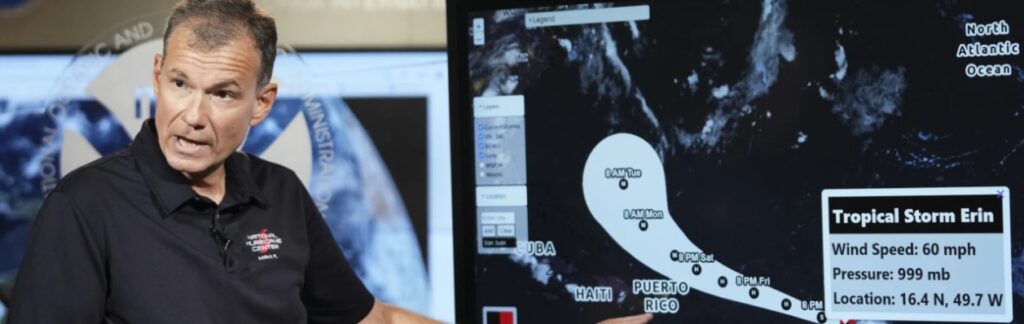
Hurricane Erin to a Category 3 hurricane Sunday as its outer bands continued to lash the Virgin Islands and Puerto Rico with heavy rains and tropical-storm force winds. While Erin’s maximum winds diminished, the storm’s overall size grew and forecasters issued tropical storm warnings for the Turks and Caicos Islands and a watch for the southeast Bahamas.
The storm wasn’t expected to directly impact the U.S. East Coast, but by doubling or tripling in size it could bring rip currents all along the Southeast coast early this week. Bermuda could have similar conditions as Erin is forecast to turn to the north and then northeast, forecasters said.
Erin reached Category 5 status Saturday with maximum winds of 260 kph after it exploded in strength, rapidly powering up from a tropical storm in a single day.
An ‘incredible’ race
Hurricane specialist and storm surge expert Michael Lowry said Erin gained strength at a pace that was “incredible for any time of year, let alone Aug. 16.” He added that only four other Category 5 hurricanes have been recorded in the Atlantic on or before Aug. 16.
The most powerful storms tend to form later in the year, with the hurricane season typically peaking in mid-September.
In October 2005, Hurricane Wilma rocketed from a tropical storm to a Category 5 in less than 24 hours, according to National Hurricane Center advisories from that time. Wilma weakened to a Category 3 hurricane before striking Florida. And in October 2007, Hurricane Felix took just over a day to go from a tropical storm to Category 5.
Including Erin, there have been 43 hurricanes that have reached Category 5 status on record in the Atlantic, said Dan Pydynowski, senior meteorologist at AccuWeather, a private forecasting company.
“They’re certainly rare, although this would mark the fourth year in a row that we’ve had one in the Atlantic basin,” Pydynowski said.
Scientists have linked rapid intensification of hurricanes in the Atlantic to climate change. Global warming is causing the atmosphere to hold more water vapor and is spiking ocean temperatures, and warmer waters give hurricanes fuel to unleash more rain and strengthen more quickly.
Erin is the fifth named storm of the Atlantic hurricane season, which runs from June 1 to Nov. 30 and is expected to be unusually busy. Six to 10 hurricanes are predicted for the season, including three to five reaching major status with winds of more than 177 kph.
If this article was shared with you by a friend or colleague, you may enjoy receiving your own copy of Travel Industry Today with the latest travel news and reviews each weekday morning. It’s absolutely free – just CLICK HERE.