


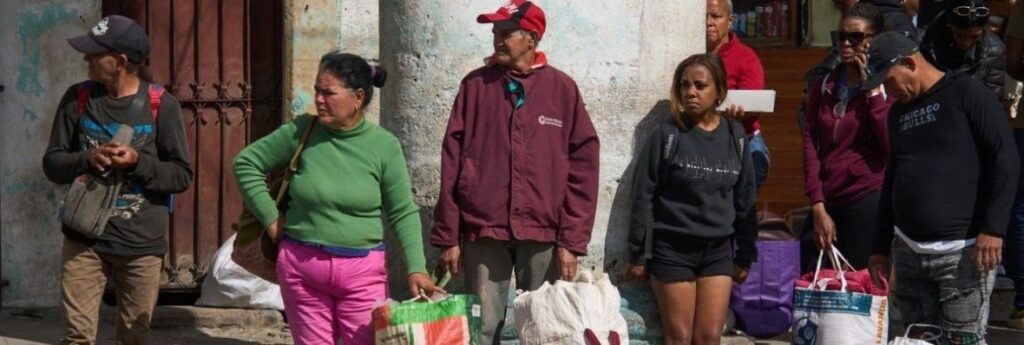
Anxieties simmered in Havana over the weekend as Cuban President Migual Diaz-Canel warned that U.S. efforts to block oil supplies would take a heavy toll on the Caribbean nation and asked Cubans to endure further sacrifices to weather the impending hardship.
Many Cubans, already reeling from years of deepening economic crisis, were left asking: What more can we sacrifice?
“I’m very worried,” said Solana Oña, who, after a day of selling books in Havana, waited patiently for a bus that never came to take her home. Instead, she spent the night sleeping in a nearby restaurant, worried that this could be the new normal if the gas that fuels the island runs out.
“Before, things were always difficult. But there was always one bus. One way to get home. Now, there are none.”
By Friday morning, working class residents like Oña were already seeing an inkling of what the future might hold.
Already unreliable public buses stopped running altogether, leaving many stranded for hours. Others were left walking large distances or hitchhiking.
Long gas lines and blackouts, a constant on the island, have grown even worse as U.S. President Donald Trump presses down on Cuba with an increasingly heavy hand, including having issued an executive order threatening to impose tariffs on countries providing oil to Cuba – a move that could further cripple an island plagued by a deepening energy crisis.
Last week, the Canadian government updated its travel advisory for Cuba, telling travellers to exercise “a high degree of caution” when visiting and being aware of the country’s ongoing shortages of power, fuel and food. The statement, also warned, “The situation is unpredictable and could deteriorate, disrupting flight availability on short notice.”
On the weekend, Bloomberg News reported that at least two hotels in Cayo Coco had closed with guests being moved to other properties as part of a government “efficiency and facility consolidation plan” in the tourism sector designed to address the fuel shortage and maximize revenues.
Canadian tour operators were continuing to monitor the situation and continued to offer packages with comment on their websites, though Air Canada Vacations had offered passengers flexible change options, stating, “We are sending this message on a Friday evening as we recognize there have been concerns and questions regarding the current situation in Cuba. While our priority remains the safety and well-being of our passengers at all times, we acknowledge the uncertainty that may exist at this time.”
To that end, ACV said that customers who had purchased a travel package to Cuba on or before Feb. 5 that included an Air Canada or Air Canada Rouge flight for travel dates through Feb. 25 could modify their booking without incurring change fees and rebook for an alternate travel plan.
It further recommended that travel agents “stay connected to your sales team by ensuring you and the team are connected to the Facebook Inner Circle page as we will always have the latest developments available.”
General traveller reports from Cuba posted on Facebook acknowledged that some guests were being moved from hotels with fewer guests, with one poster stating, “I think they’re trying to give everyone an upgrade,” and adding, “one thing I’ve learned from over 30 years in Cuba is Cubans are resilient!”
Others said there was nothing out of the usual at their resorts.
Throughout the crisis the Cuba Tourist Board has maintained that tourists are not being affected and the country has reassured Canadian airlines and tour operators that plenty of fuel is being held in reserve for them and to help keep the critical tourism industry functioning. Many resorts have their own generators and private supply lines, the board adds.
In Havana over the weekend, however, much of the city of 2 million – schools, banks, bakeries and shops – continued to operate as usual, underscoring how normal the crisis has become on the Caribbean island. Taxis, shared electric motorcycles and other transportation organized by some employers were still working in Havana’s capital, however, taxi fares remain far out of reach for the many Cubans living on a state salary of less than $20 a month.
While the U.S. announced $6 million in aid to Cubans Thursday night, left with few alternatives, many Cubans now say the current economic turmoil U.S. policies have wrought on their daily lives is comparable to the severe economic depression in the 1990s known as the Special Period, following cuts in Soviet aid.
“What does it mean to not allow a single drop of fuel to reach a country?” said the president, Díaz-Canel. “It affects the transportation of food, food production, public transportation, the functioning of hospitals, institutions of all kinds, schools, economic production, tourism. How do our vital systems function without fuel?”
For Cristina Díaz, a 51-year-old mother of two, the answer was to walk to her work as a house cleaner. She was joined by packs of others in the capital that strolled along the side of the road on Friday, once again adapting to a new reality.
“We’re living as best we can,” Díaz said. “What can I do? I live here, I was born here and this is my lot. I have to walk to get to work and to be able to feed my children.”
If you enjoyed or found this story useful, we’d appreciate if you would forward it to a colleague or friend who may also enjoy it. If, on the other hand, a friend shared it with you, welcome! You can get all the latest travel news and reviews from Travel Industry by simply clicking HERE.