
Panic erupts in the McCallister household as soon as the day begins. The parents’ alarm clock never rings, bags and coats spill across the floor, and the family barrels out the door to catch a flight to Florida in “Home Alone 2.” The pandemonium intensifies at the airport.
There, the McCallisters must dodge fellow holiday travellers and luggage as they sprint to their gate while final boarding calls echo overhead. Amid the mayhem, 10-year-old Kevin accidentally boards the wrong plane and finds himself alone in New York City just days before Christmas.
More than 30 years after “Home Alone” turned travel chaos into comedy, the frantic opening scenes of the movie’s 1992 sequel still hit close to home, especially as the busy year-end travel period gets underway. But would Kevin McCallister still end up “Lost in New York” in 2025?
In an age of federal airport security checkpoints and digitized air travel, the fictional character played by Macaulay Culkin almost certainly wouldn’t have gotten onto a commercial airliner by himself, said Sheldon Jacobson, who studies air travel operations and security and whose research contributed to the design of TSA PreCheck in the U.S.
“In the 1990s, it was plausible,” Sheldon said. “It was close enough to plausible that people weren’t rolling their eyes at it, but this would not happen today.”
Mix-ups in movie much less feasible
The Sept. 11, 2001, attacks fundamentally changed how travellers move through airports, ushering in government-run security screenings, mandatory ID checks and restricted gate access. Before 9/11, travellers could head straight to their plane with little more than a paper ticket. Now, every passenger and bag is screened, names are checked against flight manifests and access beyond security checkpoints is tightly controlled.
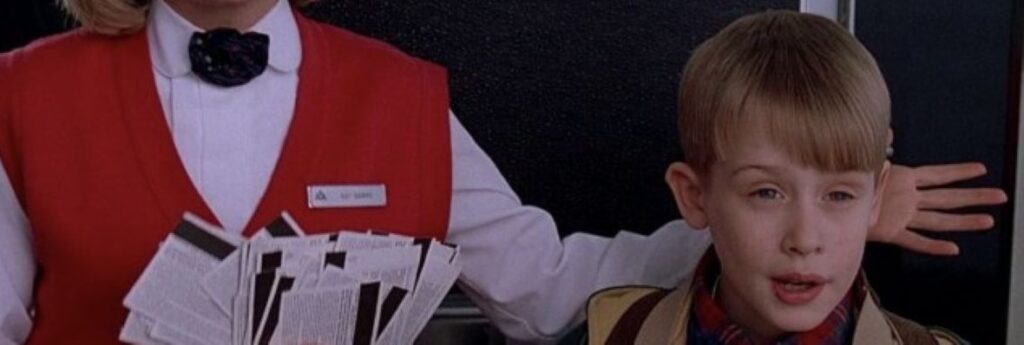
Even the paper tickets that made Kevin’s mix-up possible are largely a thing of the past. In the film, Kevin frantically trails a man wearing a coat like his father’s to the wrong gate at Chicago O’Hare International Airport, then crashes into an airline agent, sending both his ticket and a stack of boarding passes fluttering to the floor. Kevin explains that his family is already on the plane and he doesn’t want to get left behind.
“Do you have a boarding pass?” the agent asks. Kevin gestures to the pile of paper tickets and is ultimately allowed onto the plane.
Today, boarding passes are tied to specific passengers, often stored on smartphones and scanned at the gate to confirm travellers are on the correct flight. The stricter unaccompanied minor policies and fees of airlines would add yet another layer of protection today, Jacobson says.
In the movie, the gate agent walks Kevin down the jet bridge and asks if he spots his family onboard. Kevin points to the stranger he’s mistaken for his father. The agent waves him on, tells him to grab an empty seat and that’s that.
Tighter rules on children flying alone
Unaccompanied minors are closely tracked today. Most carriers require children under a certain age, often 14 or younger, to be formally registered as unaccompanied minors if they aren’t traveling with an adult, Jacobson says. That comes with special paperwork and airline staff members who are assigned to escort a child through the airport, to their seat on the plane and off the plane at their destination.
Even if every current safeguard somehow failed, a passenger on the wrong plane would get noticed quickly, Jacobson says. Flight attendants review passenger counts and special-service lists before departure. A 10-year-old boy missing from one flight and an extra child on another would trigger immediate alarms.
In other words, the movie magic holds up 33 years after “Home Alone 2: Lost in New York” came out, but the logistics do not.
“We take for granted that we had those freedoms back then that we don’t have today, for good reason,” he says. “We had to give up those freedoms in exchange for other freedoms, like safer air travel.”
If this article was shared with you by a friend or colleague, you may enjoy receiving your own copy of Travel Industry Today with the latest travel news and reviews each weekday morning. It’s absolutely free – just CLICK HERE.