


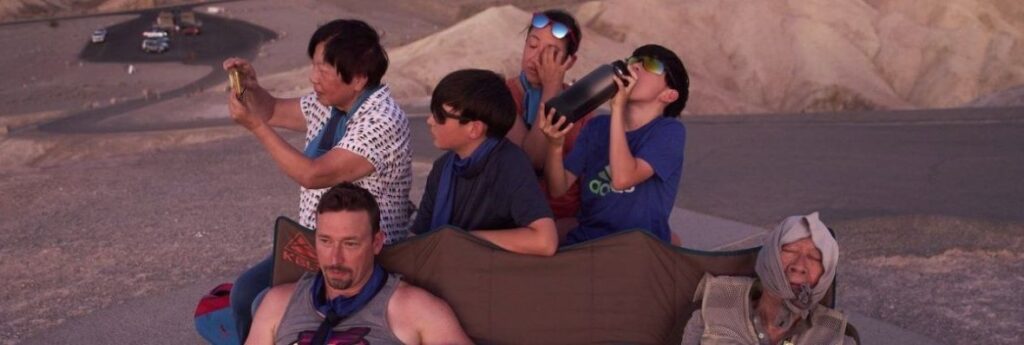
Despite its extreme, sometimes deadly temperatures, Death Valley National Park attracts countless visitors every year, some determined to finish a grueling, multi-day race, others just curious about the sizzling heat and the California landscape’s vast beauty.
Yet despite the warnings – the heat kills one to three people annually – park rangers respond to overheated visitors multiple times per week, making communication about heat safety a priority for the National Park Service. But that’s easier said than done.
“It’s very easy to underestimate how dangerous heat is,” said Abby Wines, the park’s acting deputy superintendent. “People are usually used to thinking of heat as something that makes them uncomfortable,” and that they can tough it out.
“This type of heat will kill,” she said.
Death Valley holds the record for the hottest temperature ever officially recorded – 134 F (56.67 C) in July 1913 – although some experts have disputed it and say the real record was 130 F (54.4 C) there in July 2021.
In the U.S., heat kills more people than other weather events combined, according to the National Oceanic and Atmospheric Administration.
Risks
Throughout Death Valley are stark warnings of the deadly heat: “Stop. Extreme heat danger. Walking after 10 a.m. not recommended,” one sign says. “HEAT KILLS!” warns another. On bathroom walls there are reminders to hydrate in the form of charts displaying the colour of pee – the darker the urine, the more you need to drink water.
Another sign warns visitors that helicopters for medical emergencies can’t safely fly amid extreme temperatures. Ambulances can often deploy in extreme heat but are not a guarantee. The safety of emergency responders is always considered.
Baruch Fischhoff, professor at Carnegie Mellon University who studies decision-making, said evidence shows that people generally underestimate risk when they have a sense of control. Information that explicitly says rescue might not be an option if it’s too hot “takes away that sense of the control that can lead to underestimating risk.”
Failing to recognize those risks can be deadly. Last summer, a helicopter was unable to fly to a rescue because of 128 F (53.33 C) temperatures. A group of visitors were travelling on motorcycles when one died from the heat, and another was treated for severe heat illness and transported to a hospital.
Rescue options are even more limited for hikers lost on a trail. Unless it’s a short distance and rescuers know where the person is, they’ll likely wait until sunset if it’s above 115 F (46.11 C). “Depending on their situation,” Wines said, that’s “probably too late.”
Warnings
Two of the park’s busiest months are in the summer, and it sees a small bump in visitors when temperatures are expected to hit the high 120s or 130s F (48.89s to 54.44s C). But it’s the moderate temperatures that tend to get people into more trouble.
“We actually have a harder time communicating our concerns about heat to the public when they visit and it’s only 100 to 115,” Wines said. The dryness evaporates sweat almost instantly, so many people don’t realize how much they’re actually sweating.
Then there’s the vastness. Death Valley has more than 50 entrances, so many visitors aren’t seeing rangers who can relay important information. Instead, they place heat warning signs in the hottest and most popular spots. But they discovered that people responded less to heat warning signs that looked permanent compared to those that seemed temporary.
For Marc Green, an expert in experimental psychology, that finding is “100% predictable.”
“People judge what to do based on specific information,” he said. If a warning sign is up all the time, even when conditions are good, it contains no useful information. “That’s why people disregard it.”
Nevertheless, park officials continue to tell visitors to avoid hiking at low elevations after 10 a.m., to stay on paved roads and near their cars. They say to drink and carry plenty of water, and to seek shade and hydrate if you feel dizzy, nauseous or have a headache.
Jennifer Marlon, senior research scientist at the Yale School of the Environment, has studied public perceptions of the health risks of extreme heat across the U.S. How people perceive heat and other climate risks varies by factors like age, race, gender, income level and where they live. Older white men, for instance, tend to have lower risk perceptions across the board, whereas women have higher risk perceptions than men.
“The challenge, though, is that the level of worry or risk perception doesn’t necessarily translate into action,” Marlon said. Optimism bias could also falsely make a person believe the heat won’t personally affect them. While studies show that experience with heat increases people’s concern, it is short-lived.
“You get a bump for like a year or so after a really big event,” she observed, “and then it just goes right back to the baseline.”
If this article was shared with you by a friend or colleague, you may enjoy receiving your own copy of Travel Industry Today with the latest travel news and reviews each weekday morning. It’s absolutely free – just CLICK HERE.