


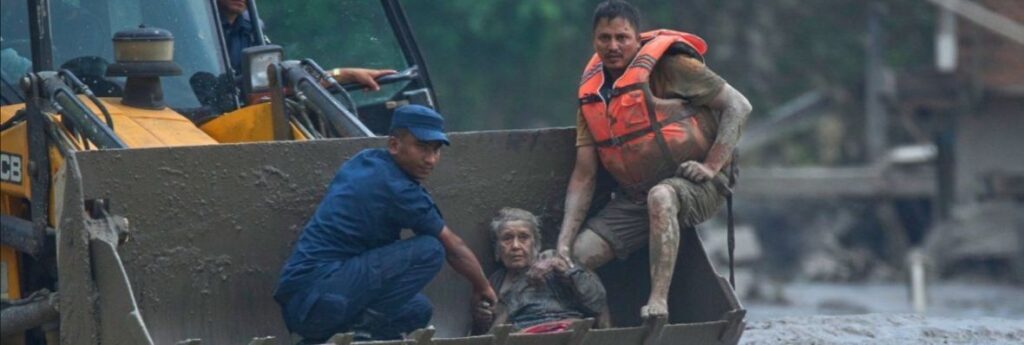
Foreign Affairs Minister Anita Anand says 30 Canadians and permanent residents are missing following flash floods that swept through an area along the Nepal-Tibet border on Wednesday.
Nepal police report at least 470 people were killed and more than 1,500 are still missing as of Friday morning after a torrent of water and mud several storeys high swept through communities, washing out buildings and bridges.
The Nepal tourism board website lists 667 foreign nationals among the missing, including 25 Canadians. None of the 31 foreign nationals reported as rescued by the tourism board are Canadian.
The United States Geological Survey initially said an earthquake led to the flooding but further analysis said the seismic event was actually caused by a glacial collapse.
Global Affairs Canada is deploying five consular officials to Kathmandu to support Canadians and work with local officials.
Anand said on social media Thursday the department is working closely with Nepali and Chinese counterparts, and co-ordinating with international partners and allies with citizens in the region.
Prime Minister Mark Carney said Wednesday all Canadians in the region should sign up for Registration of Canadians Abroad, a free service that lets the federal government contact and assist citizens during an emergency in other countries.
Global Affairs Canada’s website says as of Wednesday 820 Canadians registered as being in Nepal and five in the Tibet Autonomous Region.
The department says establishing full communication with those on the ground is challenging due to power outages in the region.
“Canadians are thinking of all those in distress right now, those who have lost a loved one, and all those who are still waiting for answers,” Carney said on social media Wednesday. “As rescue efforts continue, Canada stands ready to provide support.”
Rescue teams
Rescue teams searched on Thursday for survivors in the Himalayan region, which is popular for trekking, guided tours or a pilgrimage to a sacred Hindu site.
Videos of the disaster showed people running before the floodwaters swallowed them up and washed-out buildings and bridges. The steep slopes and the lush valleys below the Himalayan mountain range – home to many of the world’s highest peaks and remaining glaciers – are especially vulnerable to flooding and landslides. Melting glaciers have become more common because of human-caused climate change.
Images showed what appeared to be the second floors of buildings in Nepal’s hard-hit Nuwakot district slathered in mud after the torrent rushed by. Debris hung from tree branches and wires, vehicles were buried and some stunned survivors were caked in mud.
Nepalese officials said that dozens of bridges were destroyed and nearly 40 kilometers of roads were damaged, complicating search efforts.
The United Nations’ humanitarian chief, Tom Fletcher, announced Thursday on X that he has ordered the release of $2 million from the U.N.’s Central Emergency Response Fund to help with medical care, shelter and water. He called the floods “horrifying.”
Climate experts at the Kathmandu-based International Centre for Integrated Mountain Development said water levels at one point on the Trishuli River rose by as much as 9 metres in half an hour.
The disaster in Nepal and Tibet is not a one-off. The increasingly unstable Himalayan ice system threatens communities, infrastructure and water supplies across one of the world’s most densely populated regions.
The region saw similar flash floods in August 2025 when a glacial lake in Tibet overflowed because of high temperatures. Nine people were killed, and critical infrastructure, including a bridge connecting Nepal and China, was damaged.
If you enjoyed or found this story useful, we’d appreciate if you would forward it to a colleague or friend who may also enjoy it. If, on the other hand, a friend shared it with you, welcome! You can get all the latest travel news and reviews from Travel Industry by simply clicking HERE.