


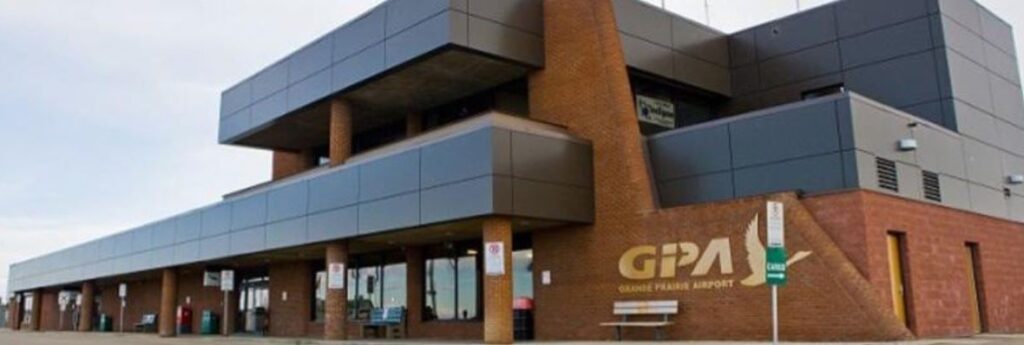
The Grande Prairie Airport – whose history spans nearly 100 years – has acted as a hub connecting not only the Peace region of Alberta but the north to the world. Its history is being explored on a set of wall panels just before the security gate in the main terminal.
“After World War One, a lot of these pilots came back to Canada and had all these skills and experience,” said Lena Gilje, Grande Prairie Airport Terminal Services manager and researcher for the project.
Their skills were utilized to launch companies that delivered mail and supplies all while maintaining their presence in the air.
In 1925, a field was cleared near the current airport to create an airstrip; a float plane base was established on Bear Lake.
The airstrip was used for forest fire detection and became recognized by local politicians as an important part of the area’s future. By 1932, there were four runways.
After the United States entered the Second World War, the Grande Prairie airport became a stop on the Northwest Staging Route to Alaska.
The United States Air Force (USAF) constructed a terminal and two runways to accommodate its aircraft on their way to Alaska.
“A lot of people don’t realize the rich history with the Air Force, both Canadian and U.S.,” said Gilje.
After the war, the airport’s operations were turned over to the Royal Canadian Air Force (RCAF) but the partnership with the United States continued.
The USAF would return in 1952 to build a radar station – part of the Pinetree Line – meant to work as an early warning detection system against a Soviet Union air attack.
The airport says USAF would also aid local search and rescue missions. As tensions rose during the Cold War, an influx of U.S. military aircraft could be seen in the sky above and on the ground near Grande Prairie.
“You’ll still see some of the U.S. military, the Black Hawks and all the helicopters use this as a fueling base because it’s one of the North’s largest tarmacs,” said Gilje.
Another common sight at the airport at the time was Canadian Pacific Air Lines, later rebranded to CP Air, offering flights to Edmonton, Vancouver, Prince George, Fort St. John, Fort Nelson and Whitehorse.
In 1981, CP Air added the Empress of Grande Prairie, a title given to planes that frequently served an area. But by 1994, the airport’s future was uncertain, as the federal government announced its intention to sell 71 regional airports including Grande Prairie.
Negotiations between the county and city began on plans to take over the airport. Eventually in 1996, the county left the talks, and the Grande Prairie Airport Commission was created. In the years to follow, the airport began to look more as it does today.
In 1999, the airport installed its first X-ray baggage machines. In 2008, it purchased its first fire truck, and in 2015, its second.
In 2014, the runway length was expanded, allowing the airport to accommodate most current passenger aircraft.
“There’s a lot that goes on here that people aren’t aware of,” said Gilje, noting that the runways can handle large air carriers. “If you’re ever studying the flight track, there are some big planes up in our airspace, and if something happened and they had to land, we can provide them that service.”
Gilje gathered much of the information from the airport’s archives and utilized the South Peace Regional Archives. “No one at the time thinks of historical archiving,” she said, noting some periods were more challenging to gather information on. We have boxes of it, so I’m working on digitizing the photos.”
If this article was shared with you by a friend or colleague, you may enjoy receiving your own copy of Travel Industry Today with the latest travel news and reviews each weekday morning. It’s absolutely free – just CLICK HERE.