


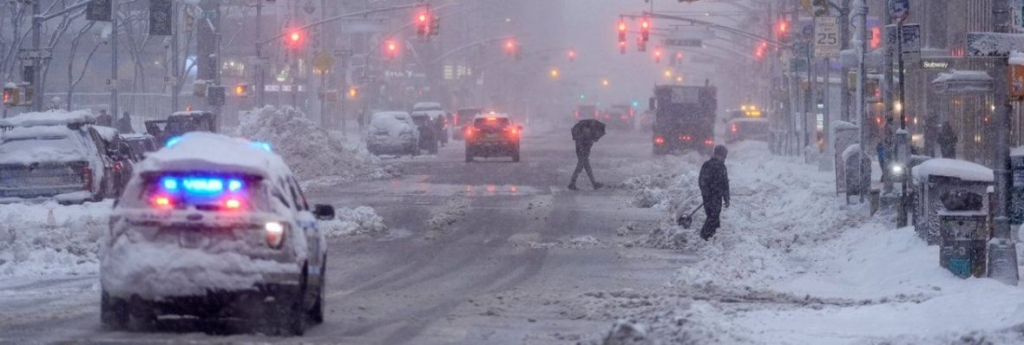
Massive snowstorms pummeled the northeastern seaboard from Maryland to Newfoundland, causing travel chaos amid strong wind and blizzard warnings, transportation shutdowns, and school and business closures. New York City remained under a state of emergency, Mayor Zohran Mamdani said during an afternoon news briefing on Monday.
The storm dumped up to 60 cm (2 feet) in parts of the U.S. metropolitan northeast as accumulations from an earlier snowfall had just melted away. Officials declared emergencies from Delaware to Massachusetts, and hundreds of thousands of people grappled with power failure from downed electrical lines.
Thousands of flight disruptions piled up Monday morning. As of around 12:30 p.m. ET, more than 5,600 flights in or out of the U.S. were cancelled, according to online tracker FlightAware. Hundreds of others were delayed.
New York’s John F. Kennedy International Airport and LaGuardia Airport had the highest numbers of cancellations Monday – followed by airports in Boston, Newark, New Jersey, Philadelphia and Washington, D.C. Rhode Island’s T.F. Green International Airport also announced Monday that it was temporarily suspending all of its airport operations.
More than 4,000 U.S. flights were previously cancelled Sunday. And over 1,700 trips scheduled for Tuesday have already been cut, in disruptions that could continue to climb.
The Federal Aviation Administration urged travellers to monitor updates and check with airlines and airports on the status of their flights.
Beyond air traffic, millions of people under blizzard warnings faced bans on non-emergency travel. On Sunday night, cellphones across New York City received wailing push alerts announcing a ban on non-emergency travel on all streets through noon Monday, due to “dangerous blizzard conditions.” Rhode Island and New Jersey implemented similar restrictions.
Amtrak announced that it would be suspending all service between New York Moynihan Train Hall and Boston South Station until at least 4 p.m. ET on Monday. Other routes also saw disruptions. Amtrak said impacted customers would be notified directly and have the chance to rebook or request refunds.
Even as the snow moved northward and tapered off in other areas, the U.S. National Weather Service said it is tracking another storm that could bring more snow to the region later this week.
The weather service referred to Monday’s storm as a “classic bomb cyclone/nor’easter off the Northeast coast.” A bomb cyclone happens when a storm’s pressure falls by a certain amount within a 24-hour period, occurring mainly in the fall and winter when frigid Arctic air can reach the south and clash with warmer temperatures.
Atlantic Canada
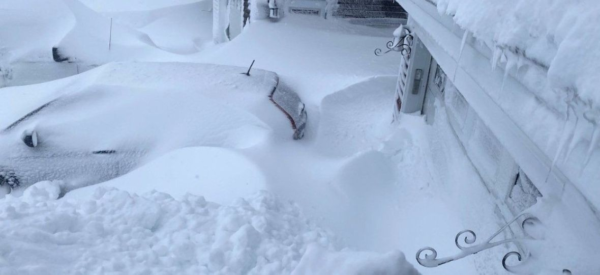
Meanwhile, Atlantic Canada’s utilities and municipalities were dealing with another day of snow and strong winds as Eastern Newfoundland was hammered by back-to-back storms that together dumped more than 110 cm of snow on the provincial capital in the past week, according to Environment Canada. Paradise, a suburb of St. John’s, has seen more than 150 cm.
St. John’s residents posted on social media Sunday night looking for help digging out as massive drifts covered doors to homes and basement apartments. The City of St. John’s issued a news release that night urging people to stay home, but stopping short of declaring a state of emergency.
Flights were cancelled Monday morning at the St. John’s International Airport, which asked passengers to verify flights with their airlines.
“Operations at YYT continue to be impacted by the recent significant snowfall,” the airport said on social media. “In order to safely resume operations, we need time to remove and manage snow from critical areas of the airport.”
The nasty weather was expected to roar into the rest of the region on Monday with most of the Maritimes are under winter storm and snowfall warnings and Environment Canada calling for totals of between 15-25 cm across much of P.E.I., Nova Scotia and southern and eastern New Brunswick.
Between 30-50 cm are in the forecast for the southeast region of Nova Scotia by dawn on Tuesday. Nova Scotia Power activated its Emergency Operations Centre at 8 a.m. Monday, saying crews were positioned across the province to respond to outages. The wind and snow can weigh down trees and pull branches onto power lines, the utility said.
If you enjoyed or found this story useful, we’d appreciate if you would forward it to a colleague or friend who may also enjoy it. If, on the other hand, a friend shared it with you, welcome! You can get all the latest travel news and reviews from Travel Industry by simply clicking HERE.