


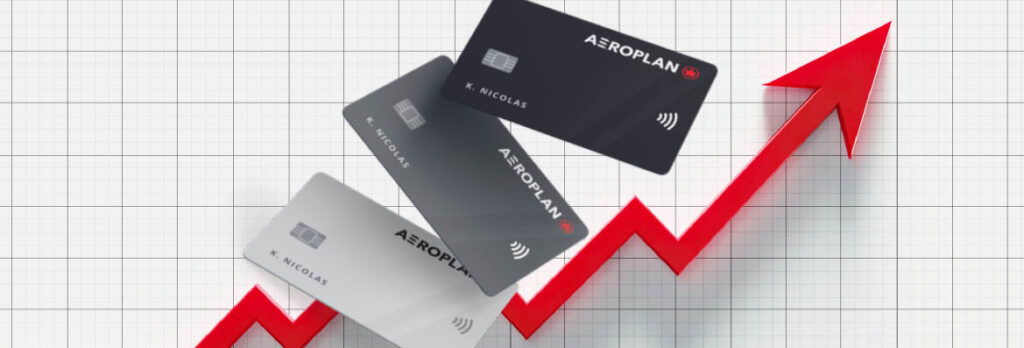
Air Canada shares took flight Wednesday after the country’s largest airline announced it would sell a quarter of its Aeroplan loyalty program to Blackstone and a trio of Canadian pension funds for $2.5 billion in a bid to bolster its balance sheet.
The carrier’s stock price jumped 12 per cent to close at $30.61 on the Toronto Stock Exchange on Wednesday.
The shares reached their highest level since early 2020, when the COVID-19 pandemic brought Air Canada’s stock crashing down from heights that topped $50 in January 2020.
The sale marks a windfall for the airline just as high jet fuel prices caused by the Middle East war deliver a half-billion-dollar hit to its earnings this year.
The buyers of the 25% Aeroplan stake are led by private equity giant Blackstone and the Caisse de dépôt et placement du Québec, the province’s pension fund manager. The Public Sector Pension Investment Board and the British Columbia Investment Management Corp. are also investors.
Air Canada says it will maintain full control of day-to-day operations at the travel rewards program, which it repurchased in 2019 for less than $500 million.
“There is no intention of relinquishing control of this valuable and strategically important component of Air Canada,” said outgoing CEO Michael Rousseau, who sought to reassure members about the frequent-flyer system.
“There will be no changes to the way members earn or burn points or to any other element of the program because of this transaction,” he told analysts on a conference call Wednesday.
Air Canada plans to use proceeds from the deal to repay $1.7 billion in bonds and buy back up to $800 million in shares in September as it looks to shore up its finances.
The sale is set to close on Monday.
The cash infusion comes after Air Canada reported a net loss of $178 million for its latest quarter, versus $186 million in profit a year earlier.
Much of that loss boils down to fuel. About 50 per cent of the airline’s tickets for the three months between April and June were already booked when the United States and Israel launched attacks on Iran in late February, said chief financial officer John Di Bert.
That meant the company was buying jet fuel at much higher rates on flights where half of the passengers had not paid steeper fares to reflect the costlier journey.
The result was a more than half-billion-dollar “hit” to Air Canada’s finances for 2026, Di Bert said.
“The bottom line is $500 million to $600 million is the headwind that, from day one, was to some degree non-recoverable,” he said.
Air Canada lowered its outlook for the year after suspending it on April 30. It now forecasts between $2.9 billion and $3.2 billion in adjusted earnings for 2026 rather than the $3.35 billion to $3.75 billion predicted earlier this year.
It also expects flight capacity will grow more slowly than initially thought, and that free cash flow may be down from the previous forecast by as much as half to between $200 million and $500 million.
However, demand has remained “intact” across the network, Rousseau said, with corporate and premium bookings particularly strong.
The Aeroplan deal amounts to Rousseau’s parting act, as he prepares to step down as chief executive at the end of the month, five and a half years after he took the reins. His retirement follows a furor over his failure to deliver a video condolence message in French after a plane crash that killed two Air Canada Express pilots in March.
An Air Canada senior executive since 2007, Rousseau was chief financial officer in 2019 when the company bought Aeroplan — spun off from the airline in 2005 — for $497 million. Now the implied valuation stands at $10 billion.
Rousseau said the board of directors will co-ordinate with executives over the five-month period between his departure and the arrival of incoming CEO Anko van der Werff, who currently heads Scandinavian Airlines — an “unusual situation,” noted ATB Financial analyst Chris Murray.
Nonetheless, observers viewed the Aeroplan deal favourably, with the stake’s valuation much higher than previously assumed.
“The announced transaction is very positive versus the scenarios we contemplated,” said TD Cowen analyst Tom Fitzgerald in a note to investors.
The terms of the agreement include Air Canada’s right to repurchase the minority stake between five and eight years from now, with a guaranteed rate of return to investors of 6.5 per cent — a “very attractive” figure for Air Canada, he said.
On Tuesday evening, Air Canada reported that revenues rose 11 per cent to $6.27 billion in the three months ended June 30 versus the same period last year.
On an adjusted basis, diluted earnings fell to 40 cents per share from 60 cents per share a year earlier, but far exceeded analysts’ expectations of 13 cents per share, according to financial markets firm LSEG Data & Analytics.
If you enjoyed or found this story useful, we’d appreciate if you would forward it to a colleague or friend who may also enjoy it. If, on the other hand, a friend shared it with you, welcome! You can get all the latest travel news and reviews from Travel Industry by simply clicking HERE.