
By MICHAEL BAGINSKI/ Despite a precipitous drop in the number of international visitors to the U.S. – not least from Canada – U.S. Travel Association president and CEO Geoff Freeman says there are many misperceptions and “untruths” about travel to the country amongst travellers, and that the Trump administration has actually done plenty of good to boost the country’s travel industry.
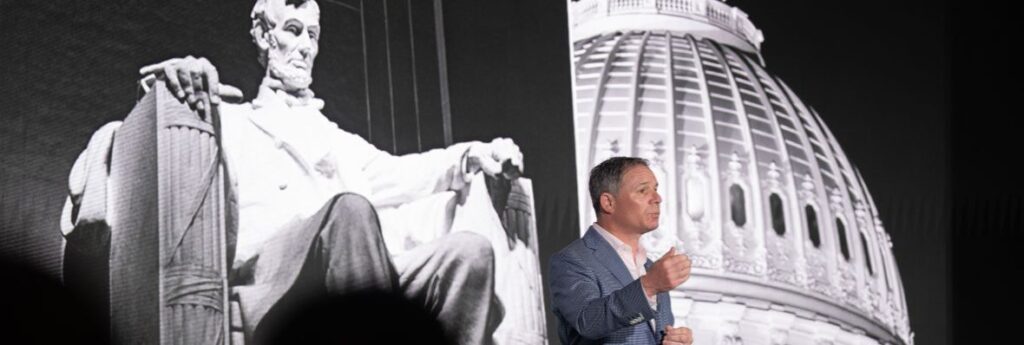
Speaking at the recent IPW travel trade show in Fort Lauderdale, Fla., Freeman stated, “These are fascinating times to say the least when it comes to international inbound travel to the United States. We’ve seen the headlines, we’ve read the stories, we’ve heard the concerns. There are some valid concerns that are out there, there are some misperceptions. And to be honest, there are probably some untruths that are out there as well.”
Freeman conceded that the U.S. last year was the only country in the world to see a decline in international travel and has seen its once $50-billion travel trade surplus reduced to a $70-billion deficit – and that there is no way to “spin” such numbers.
“While global travel grew by more than 10%, travel to the United States declined by 5%,” he added, calling it a “concerning story.”
As to why that’s been the case, Freeman believes a variety of reasons have led to the decline, such as the strength of the dollar, issues flying over Russian airspace for Asian travellers, and, of course, the perception and concerns that many travellers have about the U.S. government policy.
“There is no one reason for the decline in travel, just like there is no one reason for the increase in travellers from (Latin America) – the story is missed,” Freeman said.
“But one thing that is clear,” he countered, “is that the United States welcomed 68 million travellers last year, third most in the world – 68 million travellers who came to this country who were safe and secure, and who hopefully had the experience that we promised.”
What are the concerns?
Freeman says that when he travels around the world, travellers primarily tell him they are worried about being detained at customs when entering the U.S. or having their devices searched.
“I hear this concern over and over and over (and) I’ve seen horror stories in the media. And yet, the percentage of people that have a device searched or a secondary screening when they enter the United States today is the exactly the same under the Trump administration as it was under the Biden administration.
“This is an example of the misperceptions that we’re confronting, But the truth is, perceptions become someone’s reality and we’ve got to work harder to send a clear message that travellers are welcome.”
The U.S. Travel boss admits there are administration policy proposals that are detrimental to the cause, policies that the organization is working hard to prevent.
One is proposed changes to ESTA (Electronic System for Travel Authorization) for travellers coming from countries where a visa is not required, whereby Customs want to be able to collect social media information and extended family contact information.
“They can ask, but that doesn’t necessarily mean that that’s going to be the policy at the end of the day. When they proposed that policy, U.S. Travel organized the industry and business allies to speak up and Customs and Border Protection received more comments on this issue than any issue in the past,” Freeman said. “We have succeeded in delaying this policy at the very least and I expect that whatever final policy comes to the table will be far different than what was proposed.”
Another policy involves an additional $250 fee for visitors requiring a visa to enter the U.S. – legislation Freeman says U.S. Travel was successful in delaying and for which it will “leave no stone unturned when it comes to stopping that unnecessary and damaging policy.”
Freeman further took aim at the recent U.S. government shutdown (which, amongst other issues, caused lengthy airport delays for travellers when many unpaid air traffic controllers and TSA officers refused to work) calling the standoff between Republicans and Democrats “embarrassing” and “unconscionable” and a harm to the U.S.’s credibility by holding travel hostage in order to achieve political goals.
Trump helps travel
Despite such “policies of concern,” Freeman says he “wouldn’t be honest” if he didn’t admit that the Trump administration has taken many steps to help the travel industry. Among them:
- 5,000 new customs officers in airports
- Improving the travel process and reducing lines
- The reduction of visa wait times around the world
- $500 million spent on the exit system for travellers leaving the country (laying the groundwork for expanding the visa waiver program)
- Securing $12 billion to modernize the air traffic control system
- TSA removing some security clearance requirements (such as removing shoes)
- Pilot program for connecting passengers to not have to go through security twice
- Hosting the Summer Olympics
- Creating a special envoy promoting American tourism around the world
“All of these are positive steps to welcome international travellers,” Freeman said, adding, “and this is exactly the right time to take those steps. We are in a once-in-a-generation moment, with the World Cup kicking off, America’s 250th birthday, the Summer Olympics (in Los Angeles in 2028)… event after event after event. All of these things will make the United States a remarkably attractive destination.”
Seeing is believing
Freeman added that recent data shows that visitors to the U.S. invariably leave with a good impression.
Citing a new survey of 1,200-plus recent international visitors (including Canadians) to the U.S., and delivering a “counter-narrative” to perception, Freeman says 91% of respondents were satisfied with their trip, 83% felt welcome, and 61% left with a more favourable opinion toward America.
The survey, conducted for U.S. Travel by YouGov within the past six months also said that 56% of travellers had improved their perception of U.S. safety and 48% said their visit made them more supportive of U.S. government policies focused on security, thereby “highlighting travel’s unique role in fostering international understanding and connection.”
“We’re in a moment when confidence and perception are shaping traveller decisions,” said Freeman. “Travel is our greatest public diplomacy tool. Every international visitor who has a positive experience becomes America’s greatest ambassador.”
But the bottom line, he concluded, is that “America wants travel, America needs travel (and) we have work to do when it comes to convincing the world that travellers are welcome. If there are concerns, they’re valid and we need to address those concerns. But if there is an experience that goes far beyond what the perceptions are, we want to share that too.”
If you enjoyed or found this story useful, we’d appreciate if you would forward it to a colleague or friend who may also enjoy it. If, on the other hand, a friend shared it with you, welcome! You can get all the latest travel news and reviews from Travel Industry by simply clicking HERE.