


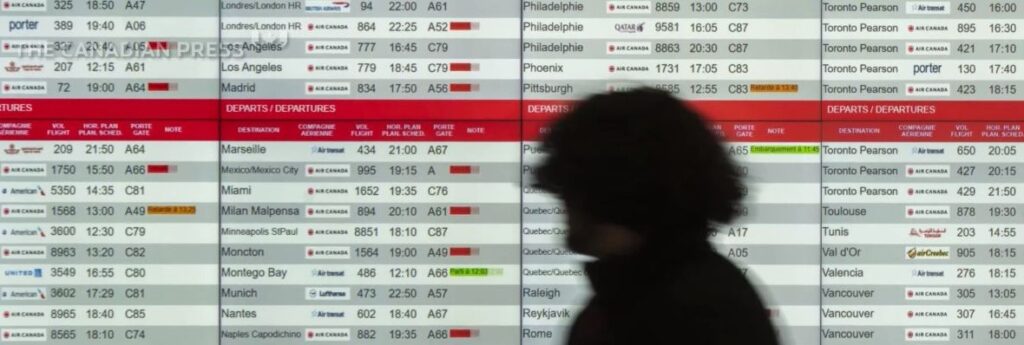
With airline tickets growing more expensive and customers facing the risk of cancelled flights, insurance experts are advising those with summer travel plans to stay on their toes.
Air carriers are continuing to grapple with sky-high jet fuel costs, an offshoot of Iran’s ongoing closure of the Strait of Hormuz, which has led to soaring oil prices globally since late February. And like their international peers, Canadian airlines have been consolidating some flights and adding fuel surcharges, leaving customers with pricier tickets and more uncertainty over whether they’ll even take off.
But that situation is now considered a “known event” by most travel insurance companies, making it harder for customers to protect themselves from financial loss — not to mention disappointment – if their plans are derailed.
“The airfare is the least of your problems,” said Martin Firestone, president of Toronto-based insurance firm Travel Secure Inc., who added the airline is obligated to refund you if your flight is cancelled.
“But none of that is any good if you need to catch a cruise, if you need get to a private tour that you’ve booked and paid non-refundable for.”
Firestone said many reputable providers made the move to exclude fuel shortage-related disruptions from coverage around mid-to-late April. Anyone who hadn’t yet purchased trip cancellation and interruption insurance by then won’t be covered if their plans are upended due to that situation.
Canadian company Tugo lists April 22 as the cutoff date on its website, noting if you didn’t purchase cancellation and interruption coverage prior, or if you already had coverage but booked your trip after April 22, it won’t apply for claims related to the jet fuel crisis.
Manulife made a similar declaration on May 5, and says policies purchased on or after that date won’t cover claims “related to this current situation … as it is now considered a known event.”
“They’ve covered their behinds to protect themselves, and rightfully so, because it could be a massive, massive amount of claims,” Firestone said.
And with carriers continuing to announce changes to their planned routes, he said it’s led to a flurry of daily calls from clients worried about their summer bookings.
“It’s happening. It’s just a question of how bad it will be and how bad it will affect people’s vacations,” he said. “You’ve got to leave yourself a lot more leeway than you ever had to because you can’t time it perfectly anymore. There’s just too much going on and you just don’t know what the future holds.”
If a fuel surcharge hasn’t already been added to a given route, it’s likely that an airline is strongly considering doing so in the near future, said Travel Health Insurance Association of Canada spokesman Will McAleer.
“I’d say you’d want to book sooner rather than later,” he said.
McAleer described what has been a tough year for the travel sector, with recent global events causing turbulence in places like Cuba, Venezuela and Mexico, along with the Middle East.
He said travel patterns have changed significantly in the ongoing “world of disruption,” and Canadians should be careful when booking trips amid the possibility further chaos will ensue.
That means shopping around for insurance packages – he said there are some providers that may not have yet designated the fuel shortage as a “known event” for exclusions – and staying nimble in case plans change on a dime.
McAleer said the majority of vacationers’ plans will likely happen uninterrupted this summer, but it doesn’t hurt to mitigate that risk as much as possible in advance.
“What we’ve seen so far is that the majority of the cancellations will likely be in shorter flights in places like Europe and … Asia,” he said. “So, if you’ve got multiple connector flights, it’s certainly something I would be looking at and I’d be getting coverage for a trip this summer.”
Firestone said his advice for clients is to “pack your patience.” He said it’s challenging for the industry to predict when or whether the Iran situation will improve – and how long it could take for oil prices to come back down afterwards.
“For the travel world, we’re looking at a very bumpy road,” he said. “Whether a flight’s outright cancelled or delayed or rescheduled is what’s up in the air right now. It’s very turbulent times out there in the travel industry and no immediate light at the end of this tunnel.”
If you enjoyed or found this story useful, we’d appreciate if you would forward it to a colleague or friend who may also enjoy it. If, on the other hand, a friend shared it with you, welcome! You can get all the latest travel news and reviews from Travel Industry by simply clicking HERE.