
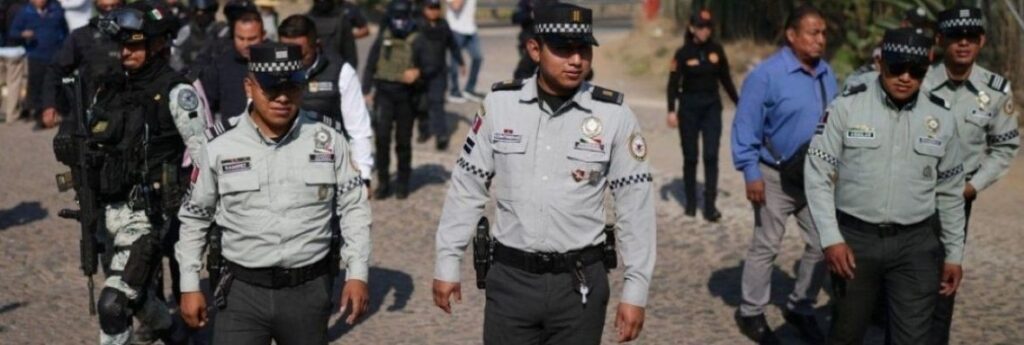
Officers with bomb-sniffing dogs circled cars and searched bags of tourists filing into historic Teotihuacan pyramids outside of Mexico City just days after a lone gunman opened fire on tourists, killing one Canadian and injuring a dozen more.
The heightened surveillance was part of a promise by Mexican authorities following the April 20 tragedy to beef up security at touristic and archaeological sites across Mexico, less than two months before the country hosts the FIFA World Cup jointly with United States and Canada.
It also set off a flurry of questions the next morning by reporters to Mexican President Claudia Sheinbaum about what security protocols her government was taking ahead of the sports competition.
About an hour from Mexico City, Teotihuacan was slated to be a key site for visitors during the festivities. Just days before the shooting, local lawmakers even pushed forward an initiative to revive a nighttime interactive light show projected on the pyramids for World Cup visitors, which was previous suspended at the beginning of the COVID-19 pandemic.
The unexpected act of violence came as Sheinbaum’s government has gone to great lengths to project an image of safety ahead of the soccer competition, following a surge of cartel violence February in the World Cup host city of Guadalajara.
“Events like this only further magnify the negative images that Mexico has on security issues, undermining the narrative that President Sheinbaum is trying to build that Mexico is a safe country,” said Mexican security analyst David Saucedo.
‘An isolated incident’
Mexico’s government has sought to turn the page on the attack and reopened the pyramids on April 22 after closing them temporarily.
That morning, tourists were already climbing up the pyramid still stained by blood to take selfies.
Sheinbaum acknowledged that the archaeological site lacked security filters to prevent the attack in part, she said, because the shooting “was an isolated incident” that hasn’t occurred before in such a public space.
While Mexico suffers from cartel violence, especially in strategic and rural areas, mass shootings in public spaces are rare in Mexico compared with the U.S., where it is much easier to legally obtain a gun.
She noted that the shooter appeared to be motivated by “outside influences,” particularly the 1999 Columbine massacre in Colorado.
“Our obligation as a government is to take the appropriate measures to ensure that a situation like this does not happen again. But clearly, we all know – Mexicans know – that this is something that had not previously taken place,” Sheinbaum said.
Mexican Security Secretary Omar García Harfuch, the face of the government’s crackdown on cartels, said that security forces had been ordered to “immediately strengthen security” at archaeological sites and major tourist destinations across the country.
He said the government will increase the presence of Mexican National Guard, boost security checks at key sites and fortify surveillance systems to “identify and prevent any threats” against citizens and visitors.
Security concerns ahead of World Cup
The announcement was an effort by Mexican authorities to assuage ongoing concerns about violence in Mexico ahead of the tournament.
Sheinbaum’s government has touted security successes under her leadership. Homicides have dipped sharply since she taken office to the lowest levels in a decade, government figures show.
But they have hit hurdles in recent months, namely a burst a violence in Guadalajara in February, triggered by the killing of Mexico’s most powerful cartel boss. The bloodshed was met with a wave of concern by people in and outside of Mexico. Sheinbaum vowed there would be “no risk” for fans coming to the tournament.
Mexico’s government doubled down on security measures, which include deploying 100,000 security forces across the country, particularly concentrated in the country’s three host cities, Mexico City, Guadalajara and Monterrey. Officials said it would deploy more than 2,000 military vehicles, as well as dozens of aircrafts and drones, and establish security perimeters around areas like stadiums and airports in key cities.
Maria de Jesús Román, who travelled to see the pyramids from Guadalajara, said while the shooting “might change the perception of tourists that come to the World Cup” she said she feels safe.
“There’s a lot of security, this is the safest place you could go in Mexico right now,” she said.
If you enjoyed or found this story useful, we’d appreciate if you would forward it to a colleague or friend who may also enjoy it. If, on the other hand, a friend shared it with you, welcome! You can get all the latest travel news and reviews from Travel Industry by simply clicking HERE.