



Canada represents a high-value long-haul market and a strategic source of demand beyond Europe’s peak summer months, particularly during the shoulder season, according to a new study, presented during European Tourism Association (ETOA) webinar series on North America outbound markets.
The study by Data Appeal and Mabrian highlights that European destinations are increasingly well placed to capture a larger share of Canadian demand during off-peak periods, thanks to demand patterns, strong travel sentiment among Canadian visitors, and growing air connectivity to major European cities.
This insight emerges from an analysis of travel sentiment and air connectivity between Canada and a selection of European destinations during 2025, offering valuable guidance for destination marketing strategies to tap into this overseas market.
Counter-seasonal growth
Canada was the second most connected overseas market to Europe in 2025, with 8.7 million available seats, according to a previous report by Mabrian. Air connectivity from Canada to major European hubs has grown significantly, particularly to Paris, where capacity rose by +7.4% year-on-year at Charles de Gaulle and by an impressive +88.3% at Orly, reaching 1.46 million seats.
This growth reflects rising Canadian interest not only in France but across Central and Southern Europe, with Paris serving as both a destination and a gateway to the region.
Munich also recorded growth in air capacity (+8.8%), while Milan and Rome experienced slight declines (-11.4% and -2.3% respectively). Despite this, Rome remains the second-largest European destination per seat availability for Canadian travellers, with 472,000 seats in 2025 connecting it to Canadian cities.
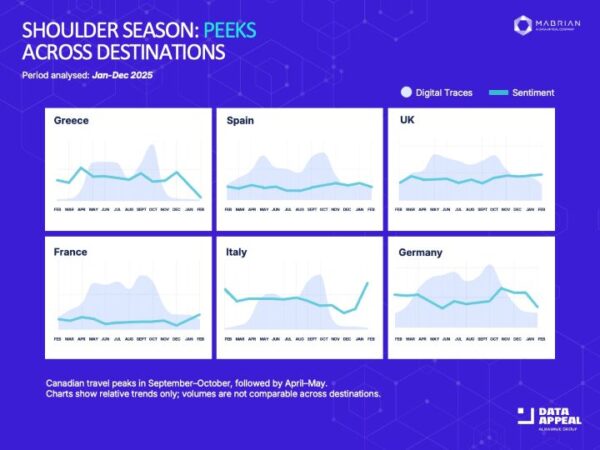
Analysis of digital traces published online by Canadian travellers across France, Germany, Greece, Italy, the United Kingdom and Spain reveals clear seasonality patterns. While each destination shows its own peaks, all demonstrate a strong presence of Canadians between September and October, with April and May emerging as the second most significant period.
“Several data dimensions show a consistent pattern among Canadian travellers visiting Europe: they tend to favour shoulder seasons over summer, making this market a key driver for European destination strategies aimed at countering seasonality and targeting high-impact long-haul inbound markets,” says Carlos Cendra, Director of Marketing and Communications at Mabrian.
Profile of Canadian travellers
The analysis also provides insight into the profile of Canadian travellers and the experiences shaping their choice of European destinations. Couples represent the largest segment, accounting for 42-49% of travellers, followed by families (22-27%). Solo and business travellers remain smaller groups, except in Munich, where they account for 21%.
Destination preferences vary, according to demand drivers analysis. Milan appeals to Canadian travellers due to the diverse mix of culture, shopping, outdoor activities and gastronomy, Rome is primarily selected for its cultural heritage (59.4%), and Paris for both artistic attractions and culinary experiences. For Canadians, Munich is chosen as a cultural destination, for its museums and cultural offerings (55.4%) and also appeals to family travellers (12.2%).
Sentiment scores on the travel experience reinforce the strength of these drivers: cultural experiences, gastronomy, quality of hospitality and friendly staff are consistently praised by Canadian travellers visiting these destinations, while pricing, booking processes, queues at major attractions, and logistical factors such as Wi-Fi, public restrooms and accessibility emerge as common friction points.
Overall, European destinations generally meet or exceed Canadian expectations, with Greece (89.8/100), Croatia (88.1/100), Finland (86/100), and Italy (85.8/100) receiving the highest appreciation. Disaggregating sentiment by language reveals distinct preference patterns: French-speaking Canadians assign higher satisfaction scores to Finland and Germany, whereas English-speaking travellers demonstrate comparatively stronger sentiment towards Spain.
“As travel patterns among Canadian outbound travellers evolve amid growing geopolitical uncertainty, it is essential for European destinations to understand this inbound market, seeking to optimize their marketing and operational strategies and better tailor experiences, aiming at capturing counter-seasonal demand, and unlock long-term growth in this high-value market,” Cendra summarizes.
If you enjoyed or found this story useful, we’d appreciate if you would forward it to a colleague or friend who may also enjoy it. If, on the other hand, a friend shared it with you, welcome! You can get all the latest travel news and reviews from Travel Industry by simply clicking HERE.