


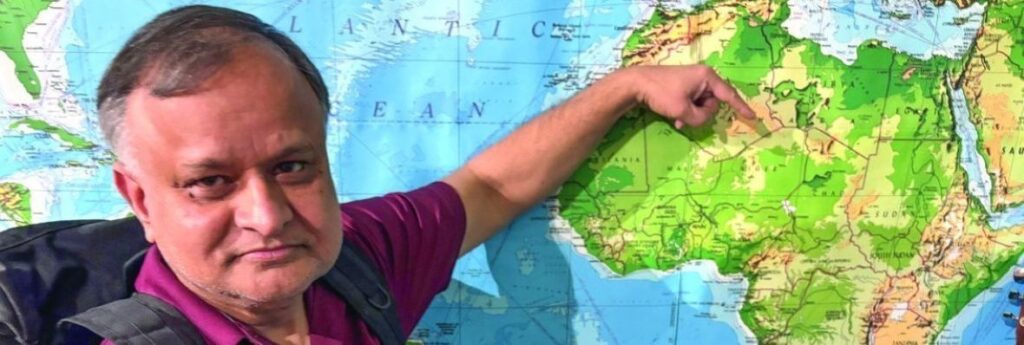
By JOE KONECNY/ If everything goes as planned, St. Thomas, Ont., world traveller Syed Hasan will be in Nigeria now, beginning a six-country solo tour of the African continent, on his way to increasing his lifetime total for independent nations visited to 193.
Hasan is on a quest to visit all the countries in the world – 195 according to the CIA World Factbook – and there are myriad things that could have gone wrong already.
However, the proprietor at Moe’s Variety – who departed from Toronto on Sunday – is counting on an informal network of Facebook friends and fixers to help navigate his passage through nations too dangerous for conventional travel planning, and red-flagged by Canada travel advisories.
After a 20-hour flight to Nigeria, he planned to be in the overwater slum of Makoko on the edge of the Lagos Lagoon by now.
His three-week sojourn will also take him through the Central African Republic, Chad and Niger, with a stop-over in Burkina Faso to secure a visa to also enter Mali. Hasan had previously visited Nigeria and Burkina Faso.
“There are five countries left in Africa, I will try to cover four of them on this trip,” Hasan, 63, said in an interview the day before hopping on a bus to Toronto to catch his flight. “Only Sudan is left in Africa (although he has already visited South Sudan). It’s closed right now, so I will wait.”
Three other destinations remain on his wish list, awaiting the nations’ acceptance of visitors: North Korea, Venezuela and Sudan. His desire to travel is rooted in a love of geography and history and fueled by childhood memories of the newspapers and magazines that his father, a teacher in Pakistan, brought home.
Hasan had planned to visit North Korea this year, hoping to secure an elusive travel visa for the communist nation by registering for a five kilometre run at the Pyongyang International Marathon. However, the race was cancelled in March.
“Yes, I’m a little bit nervous,” he said on Saturday, contemplating the journey ahead.
“My son asked me if I’m excited, and I said no, I’m apprehensive,” he added. “You don’t know, even in the Central African Republic. Anything can happen. There are no guarantees.”
If he encounters a major roadblock, his backup plan is simply to buy an airline ticket and return home.
“Eight months ago, a group from Germany went with the same invitation that I have, and for some reason, they arrested all of them, and they were in jail for three days,” added Hasan, seeming undaunted by the scenario. “These are all military governments. They don’t want people coming, and they ask, why are you coming, what do you want to see? For Canadians, they’re a little bit lenient. I’m not afraid.”
His wife Iffat Farooqui, son Zuhayr Hasan, and daughters Uroosa, Sabah and Sameera Hasan, don’t accompany him on such dangerous trips. “They’re used to my going,” said Hasan. “They’re very supportive. I told them, once I’m done with the remaining countries, we will go together to some place nicer, like Indonesia, Malaysia, Japan, or China.”
Hasan doesn’t think of himself as an Indiana Jones, the fictional archeologist who travelled the world battling villains and searching for artifacts, but he does appreciate comparisons to explorers like Marco Polo.
“Yeah, I’d like to be like them, taking chances,” he mused. “They did it when there was nothing, no airplanes, it was quite a thing. It’s not that difficult now, other than it costs money.”
He admits to having a mischievous appetite for witnessing the dangerous cultures and landmarks of the world. “When I lived in California, whenever someone visited me, I used to take them to South Central Los Angeles. In some movies, like Boyz n the Hood, it shows how bad it is there. I’d say let’s go, I’ll show you.
“It’s just so different, not normal. So, you want to see how bad it is, how people live there. I want to see that.”
So, Hasan has cobbled together a make-shift African travel itinerary based on the guidance and experiences of friends on Facebook.
These Facebook friends also suggest fixers, intermediaries, or guides who accept e-transfers for payments to arrange travel visas, and other necessary documents not easily available to outsiders.
“There are good people there,” said Hasan. “They write their trip details, tell me this happened, and that happened. It’s very helpful.”
Judging by his social media network, Hasan estimates there are at least another 100 people with dreams of travelling to all the countries in the world.
“There are so many horror stories too, like the guy from Germany who sent 600 Euro (Cdn$964) and didn’t get any service, nothing, and there was no one to complain to,” he added.
“The guy who is helping me (in Nigeria) is very trustworthy,” he said. “One of my friends, she’s from Norway, she was there last week, and she had very good words to say about him, said he’s very reliable, especially when it comes to money.
“Yes, some of them are not legitimate,” he said. “In the Central African Republic, most of them are cheaters. There’s one guy, Chris, so many bad stories, people send him $500 or $1,000 and he says he did not get it, and there’s nothing you can do.”
If any of the mediators fail Hasan on this trip, and don’t meet him at an airport as planned, for example, Hasan said “there will be a big problem, and they’ll deport me right away. I’m ready for that. They send you back to where your flight originated.”
Nigeria
His first stop is the English-speaking Nigerian slum of Makoko, sometimes referred to as the “Venice of Africa” due to its network of waterways and buildings on stilts.
“Nigeria should be no problem, but I did hire a guide because Lagos is a very big city, 20 million people, so it’s good to have someone the first day. On the second day, I will be on my own.
I booked a hotel right close to the airport, because it’s safer.
“I want to see Lagos city,” explained Hasan. “There are some nicer areas than Makoko – it’s very bad there – like Victoria Island, where it’s very beautiful, and I want to take a train from Lagos to Ibadan, because China built this railway and I’d like to see how it is. I like trains. Whenever possible, I ride trains.”
Next, he’ll be off to the French-speaking Central African Republic. Hasan knows only a few words in the French language.
“There’s a problem in visiting these countries,” he explains. “No borders, no roads, you can’t go by bus or car. I will fly from Lagos to Bangui the capital of the Central African Republic.”
While the physical distance between those cities suggests less than a three-hour flight by North American standards, Hasan will be forced to take a circuitous route that takes much longer and costs upwards of $1,000.
“There the guide will come to the airport, they will keep my passport for the weekend, and I will go to the embassy on Monday, to get it back, when there will be fingerprinting, and whatever else.
“The Central African Republic is the only country that does that and because of that, you feel very uneasy because your passport is not with you, because the embassy is closed on weekends,” he said. “Then when you go to the office, they give you the run-around, because they want bribes.
“So, I booked my flight out for the Tuesday,” he explained. “I didn’t want to take a chance. What if they don’t give me my passport? But the guy (fixer) said he would help me speed up things.”
While he’s waiting, Hasan is reluctant to stray far from the hotel because The Wagner Group, a Russian state-funded private military company, patrols the streets. “But my guy said he would take me to the Boali Falls, and a pygmy village. Even within the city, it’s very tough to move around. If they see you taking pictures, you’ll be in big trouble, and your guide too.”
Chad, Niger, Burkino Faso, Mali
Moving on to Chad, the flight to N’Djamena will also be time consuming and cost about $1,200. “I will be there for three days. The guide will come to the airport to pick me up and be with me everywhere. He’s like the guy who will talk to anyone if there are any problems. If they see you walking alone, police or armed guards will stop you for no reason and ask you what you are doing.”
French-speaking Niger is next. “I asked (the guide) not to book any fancy places for me, don’t take me to fancy restaurants, I want to see the real Nigerians and how they live.” That fixer charges 680 Euros (Cdn $1,094), plus expenses, he said.
From there, he goes to Burkina Faso. “I will be there on a Wednesday night. Thursday I will go to the embassy, give them some bribes to get visa on the same day, then I will fly to Mali on Saturday or Sunday.”
With an overall travel budget fueled by his family’s frugal lifestyle, to cover his day-to-day needs “I carry cash, American dollars, plus a debit card,” said Hasan. “You have to have cash on these trips because at most places, you cannot find an ATM.”
When his odyssey concludes, Hasan foresees putting pen to paper and compiling a travel book.
“Once I’m done with all of them, then I will sit down. I have all the material (currently decorating his basement). My store takes too much time and I’m thinking about selling it in the next two-to-three months, then I will have time to concentrate.
“Many people are interested in this kind of thing, travelling, far-off lands, off the beaten path, people want to know how it was.”
Although he travels light, carrying only what appears to be a 30-litre backpack, Hasan also brings along some pencils, pens and notebooks to donate to the children he encounters.
“My family also gave me money to give,” he said. “Children don’t have shoes. They don’t have clothes. You’ll see a little girl, with a torn shirt, and she’ll be hiding like that,” he said, gesturing to demonstrate how a child may be hiding her belly. “It’s so bad. You can buy second-hand clothing there and give it to them.”
“If you enjoyed or found this story useful, we’d appreciate if you would forward it to a colleague or friend who may also enjoy it. If, on the other hand, a friend shared it with you, welcome! You can get all the latest travel news and reviews from Travel Industry by simply clicking HERE.“