


By MICHAEL BAGINSKI/ Start with the name. It’s Guad-el-oup – which is to say, not Guad-a -loup-eh (a city in Mexico). You could call it “the biggest small island in the Caribbean,” as some inhabitants boast, or, better still, just call it Gwada, as the locals do in their creole dialect.
Know also that Guadeloupe is not a singular island, rather that the “Islands of Guadeloupe” are comprised of six distinct constituents – and further that, beyond Quebec, they have rarely resonated with most English-speaking Canadians.
“In my 30 years as an agent, I don’t think I’ve had anybody ask me about it,” says travel advisor Tammy Morgan of Maritime Travel in Pickering, Ont., who took part in a recent FAM to the islands with four other agents and Travel Industry Today.
But that may be about to change as the British television series “Death in Paradise,” which is notably filmed in Guadeloupe, continues to attract large audiences; and, more importantly, Air Canada offers first-ever service to the islands from Toronto this winter to supplement the carrier’s remarkable five decades of flights from Montreal, which now number four to six a week depending on the season.
Air Transat is also a long-time partner of the islands and expanded its reach in February with service from Quebec City.
Guadeloupe Islands Tourism Board CEO Rodrigue Solitude recently told Travel Industry Today in an interview that while 100,000 Canadians currently visit Guadeloupe annually, the tourism board expects the total will increase by half with the new flights. Indeed, Canada is already the islands’ No. 2 market (after France) and notably ahead of the U.S., he said.
And with Air Canada’s Toronto service to Pointe-à-Pitre (PTP), which ends later this month (April), having proven a success, the carrier plans to be back again in the fall – just in time for the much-anticipated opening of the four-star Pullman hotel, which will add to the nearly 8,000 traditional rooms in the islands, which range from villas and apart-hotels (Habitation Grand Anse), to luxury resorts, plus alternative accommodations such as Airbnbs. Club Med La Caravelle ranks as the highest profile resort in the islands, and the only true all-inclusive.
The tourism board has also appointed Toronto-based representation firm VoX International (account manager Carla D’Andrea) to help develop the market outside of Quebec, joining Montreal-based tourist board rep Jonathan Chipotel.
French connection
Exuding natural beauty, cultural depth, and the warm, welcoming spirit of Creole life across its six primary islands, Guadeloupe is one of three overseas regions of France (not unlike Tahiti on the other side of the globe) in the French West Indies which, along with Martinique and St. Martin, vibe a tiny slice of Europe that, for example, uses euros in the Caribbean.
And with support from France, the roads and general infrastructure (including public restrooms) is excellent, and the islands are safe and clean.
The widespread use of English is improving, with the tourism industry in particular making a conscious effort to become more linguistically proficient to serve the growing English market –but dusting off one’s high school French can prove useful on occasion.
All of Guadeloupe’s islands – the main ones are Grande-Terre and Basse-Terre, along with Marie-Galante, La Desirade and two Iles des Saintes – are blessed with welcome tropical charm, though each with their own attributes, ranging from pristine beaches for sunbathing and watersports to lush rainforests with rich biodiversity, and distinctive culinary traditions to vibrant local customs and festivals.
Grande-Terre
Shaped like a butterfly – the ubiquitous symbol of Guadeloupe – Grande-Terre and Basse-Terre are separated by little more than a river, with the main city of Pointe-à-Pitre (and its airport) at the apex.
The eastern wing of the Guadeloupe’s butterfly, Grand-Terre is known for its dramatic Atlantic coastline and seaside villages and most of the resorts and best beaches are found here (including the Club Med, and the islands’ only five-star – the luxury boutique La Toubana Hotel & Spa Hotel, which offers elegant rooms and villas, plus panoramic ocean views and a private beach.
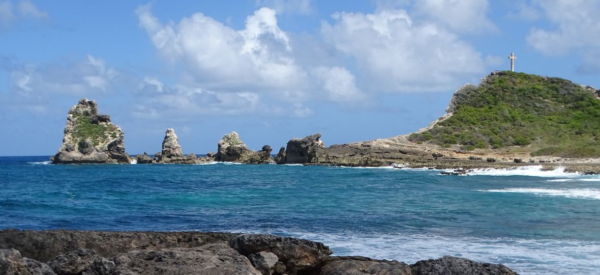
A must visit is Pointe des Châteaux, one of the island’s most spectacular natural landmarks with dramatic cliffs overlooking the Atlantic Ocean. After a short hike to the top, visitors can often see La Désirade, another island of the Guadeloupe archipelago.
Tip: Located near Sainte-Anne and directly across a small bay from the Club Med, La Toubana is an ideal option for luxury travellers and honeymooners. Refined travellers will also not be disappointed at Relais du Moulin, a boutique hotel and restaurant built around a restored 18th-century windmill, reflecting the island’s sugar plantation history. Club Med suits families but also features a more subdued adults-only section.
Basse-Terre
Home to Guadeloupe National Park, which protects over 74,000 acres of rainforest, Basse-Terre has waterfalls, including Cascade aux Écrevisses (the Crayfish Waterfall – one of the most accessible in the national park), volcanic landscapes, and remote beaches, notably Grande-Anse Beach, widely considered one of the most beautiful in Guadeloupe.
Offshore and below the waves, snorkellers can discover the Cousteau marine reserve, named after ocean explorer Jacques Cousteau, and one of the Caribbean’s most famous snorkeling spots.
Tip: For serious snorkelling in the marine reserve, Anbadlola (www.guadeloupe-plongee.fr/) provides jet boat transfers, knowledgeable guide (in the water), plus first-rate gear, including dry suits, allowing for a stress-free two-hour in-water excursion to see fish, coral, and. with luck. a turtle or two. Another, less intense snorkelling option is sailing by catamaran to the Grand Cul-de-Sac Marin, a protected lagoon within the national park (and UNESCO Biosphere Reserve), with Azimut Croisiere (www.azimutcroisiere.com). The full-day excursion Includes drinks and a delicious (rare) sit-down lunch.
Deshaies
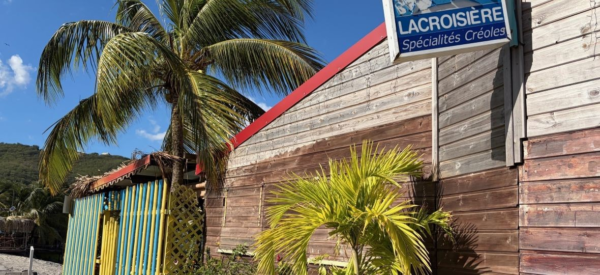
Near the colourful town of Deshaies, which draws fans of “Death in Paradise,” which is filmed there, is the Langley Resort Fort Royal, a stylish four-star uniquely spread along the beach and offering the best sunsets on the island.
Visitors to the area can also check out the Botanical Garden of Deshaies, featuring tropical plants, waterfalls, and Caribbean views, or visit the excellent Gwakako chocolate workshop in Pointe Noire, where Claude Alvado, who is perhaps the last chocolatier in Guadeloupe, teaches visitors about the history of cacao production and offers a hands-on opportunity for participants to roast, peel and grind cacao grown onsite into their one authentic drinks and chocolate bars. “If I don’t do this, the history is gone,” he told us. (www.gwakako.com).
Les Saintes
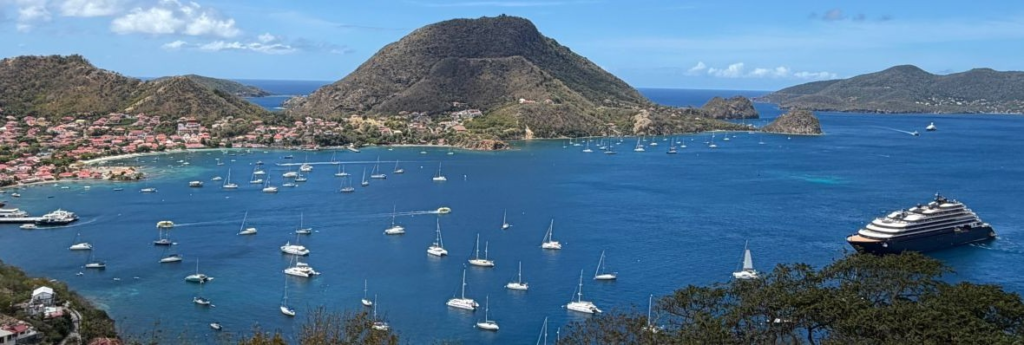
If visitors pick only one excursion, make it a trip to Les Saintes, where a 30-minute jet boat or ferry ride lands daytrippers in colourful Terre-de-Haut, teeming with boutiques, cafés, bars, and restaurants. And then off by bike or rented golf cart to Fort Napolean (an interesting relic of the era, though Bonaparte never lived there) for an interesting history lesson on the islands and the best views of the amazing bay, considered among the beautiful in the world and another great snorkelling spot. A popular port for boutique cruise ships, the Ritz-Carlton yacht was anchored when we were there (banner photo).
Tip: For those wanting to stay a night, consider Bois Joli Hotel, a small seaside property located directly on the bay of Terre-de-Haut with beautiful harbour views. Recommended tour operator: Malawy Excursions, https://mawalyexcursion.com/ .
Pointe-a-Pitre
All roads in Guadeloupe go through Pointe-à-Pitre, the cultural and commercial centre of the islands. And while most will stay outside the city, a tuk-tuk tour is a great way to discover the city’s historic streets and colourful architecture, including over 300 murals and ubiquitous graffiti art. The major cultural institution in town is the Memorial ACTe Museum – a “birds nest” building dedicated to the history and legacy of the transatlantic slave trade.
A good accommodation option is La Créole Beach Hotel & Spa. a beachfront resort located in the lively seaside area of nearby Le Gosier, known for its calm waters, restaurants, and relaxed Caribbean atmosphere. The hotel features tropical gardens, multiple restaurants, and direct beach access.
Getting around
Simply put, visitors are advised to rent a car. Roads are good and traffic civilized, and driving is on the right. Moreover, public transit in Guadeloupe is limited, taxis are expensive, and Uber does not exist. Tour company packages do not include transfers.
Guadeloupe is also a popular cruise port, with lines such as MSC and Costa calling regularly.
Tip: Canadians can drive for up to 20 days with their domestic drivers license after which an international drivers permit (IDP) is required.
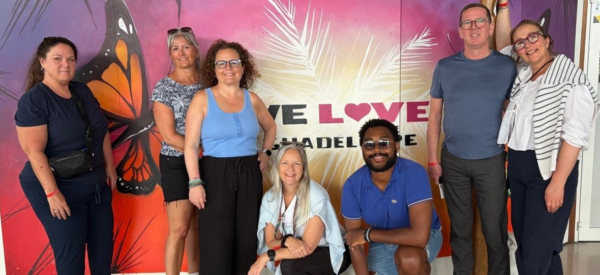
Coming next: Watch for the next story in this series as the travel advisors who travelled on the FAM share their views.
If this article was shared with you by a friend or colleague, you may enjoy receiving your own copy of Travel Industry Today with the latest travel news and reviews each weekday morning. It’s absolutely free – just CLICK HERE.