


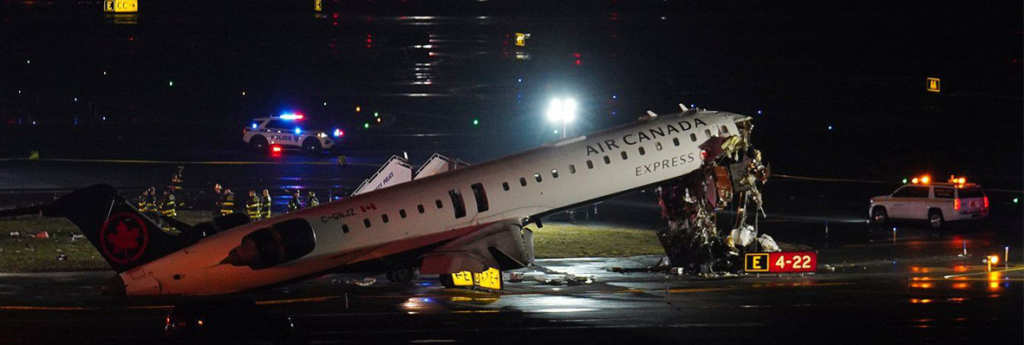
A fatal collision between an Air Canada jet and a fire truck at LaGuardia Airport late Sunday has drawn attention to the demands that a strained navigation system places on traffic controllers, and how even strict protocols failed to prevent tragedy.
Experts say it’s not uncommon — particularly late at night when takeoffs and landings are fewer — for the same air traffic controller to handle both incoming aircraft and groundcrew movement, as appeared to be the case Sunday based on tower communications from LaGuardia. But they also say it raises questions about whether more bodies are required and the risks of a staffing shortage that has plagued the industry for years.
As has been widely reported, an Air Canada jet carrying more than 70 passengers collided with a fire truck while landing at New York’s LaGuardia Airport late Sunday, killing the pilot and copilot and injuring several others.
Audio from the tower revealed that a controller had been dealing with an earlier emergency when he cleared Air Canada Express Flight 8646 to land. Less than a minute later, he cleared a fire truck to cross the active runway.
Footage viewed by The Canadian Press shows the Bombardier CRJ-900 jet speeding along the nighttime runway as the truck crosses its path, turning away too late from an impact that unleashed a trail of smoke and debris.
“I messed up,” the controller says. “We were dealing with an emergency earlier.”
The collision occurred shortly after 11:30 p.m. on Sunday as the plane — operated by Air Canada Express carrier Jazz Aviation — touched down in New York City after its journey from Montreal’s Trudeau airport. The crash killed two pilots and sent 41 people to hospital.
New York-based aviation accident lawyer Erin Applebaum called the incident “an avoidable tragedy.”
“This is a controller’s absolute worst nightmare,” she said.
“It’s important to point out that there was another emergency going on at the same time. It was just a confluence of factors.”
The fire truck was crossing the tarmac after being given permission to check on another plane reporting an odor onboard. Before the collision, an air traffic controller can be heard on airport communications frantically telling the fire truck to stop.
Roughly 20 minutes later, the controller appears to blame himself. “We were dealing with an emergency earlier,” the controller said. “I messed up.”
About 40 passengers and crew members on the regional jet from Montreal, and two officers from the fire truck, were taken to hospitals, some with serious injuries. Most were released by Monday morning, authorities said.
The impact crushed the plane’s nose, leaving cables and debris dangling from the mangled cockpit. Images from the crash site showed the fire truck flipped onto its side, with most of the damage to its back half.
The pilot and copilot who died were both based out of Canada, said Kathryn Garcia, executive director of the Port Authority of New York and New Jersey, which operates the airport.
Trump claims ‘mistake’ before investigation
The airport was to remain closed until at least early Monday afternoon during the investigation, which is being led by the National Transportation Safety Board.
However, regardless of any investigation, Donald Trump told reporters, “They made a mistake,” and called it a “terrible” situation.
Canadian Prime Minister Mark Carney said in a statement the accident was “deeply saddening.”
The fire truck was traveling across the runway to respond to a separate incident aboard a United Airlines flight, whose pilot had reported “an issue with odor,” said Garcia, who deferred additional questions about the sequence of events to the NTSB.
Two Port Authority employees in the fire truck suffered injuries that were not believed to be life-threatening, Garcia said.
A key question for investigators will be examining coordination of the airport’s air traffic and ground traffic at the time of the crash, said Mary Schiavo, a former Department of Transportation Inspector General. “I don’t know how many wake-up calls the (Federal Aviation Administration) needs, but this has been happening for years and sadly some of the most horrific air crashes in history happen on the ground at the airport.”
The crash shut down LaGuardia — the New York region’s third busiest hub — until at least Monday afternoon, during what was already a messy time at U.S. airports because of a partial government shutdown.
More than 600 flights had been cancelled at LaGuardia by midday, according to FlightAware.com. The shutdown was causing some disruptions at other airports, too, especially for Delta, which has a major presence at LaGuardia.
Passenger says they helped each other escape the plane
Passenger Rebecca Liquori said that after the plane hit turbulence while descending, she felt it brake hard and heard a loud boom.
“Everybody just jolted out of their seats. People hit their heads. People were bleeding,” Liquori told News12 Long Island, a station where she once worked before becoming a nurse.
Liquori, who said she helped open the emergency exit door, recalled passengers helping each other slide down a wing to get out.
“I’m just happy to be alive,” said Liquori, who had gone to Montreal for a cousin’s baby shower. “I would have never pictured a one-hour flight that I’ve done countless times … ending like this.”
Flight originated at YUL
There were 72 passengers and four crew members aboard the Jazz Aviation flight operating on behalf of Air Canada, according to the airline. The flight originated at Montreal-Pierre Elliott Trudeau International Airport.
Stairways used to evacuate passengers were pushed up to the emergency exits on the jet, a Bombardier CRJ. Hours afterward, the plane remained on the runway with its crumpled nose tilted upward.
An air traffic controller tried to warn the fire truck.
The air traffic controller tried to stop vehicle after giving clearance
“Stop, Truck 1. Stop,” the transmission says. The controller can then be heard frantically diverting an incoming aircraft from landing.
Air traffic controllers are not impacted by the partial government shutdown that has caused long delays at airport security checkpoints in recent days. They have been affected by past shutdowns.
The FAA has been chronically short on air traffic controllers for years with some of most recent estimates showing that at least 3,000 additional controllers are needed. But former FAA air traffic control chief Mike McCormick said that LaGuardia is “not a control tower that has perennial staffing problems.”
But at the time this crash happened, the tower would have been lightly staffed during the overnight shift, he said. Investigators will also look at how much overtime and how many days in a row the controllers had been working to determine if fatigue could have been a factor.
LaGuardia is one of 35 major U.S. airports with an advanced surface surveillance system that’s designed to help the tower keep track of planes and vehicles crossing the airport.
An alarm that can be heard in the background of the air traffic control audio was likely from the system and would have prompted all eyes in the tower to look out the window or at the system’s display to find the potential collision, McCormick said.
“It’s an aid in a situation like this,” he said, but the system doesn’t know if someone has given clearance for a vehicle to cross a runway.
FAA statistics show there were 1,636 runway incursions last year.
LaGuardia was 19th busiest in 2024 out of more than 500 U.S. airports, with over 16.7 million passengers boarding there, according to a 2025 FAA database.
The Transportation Safety Board of Canada has sent a team of investigators to assist the U.S. officials at LaGuardia.
If you found this story useful, we’d appreciate if you would forward it to a colleague or friend who may also enjoy it. If, on the other hand, a friend shared it with you, welcome! You can get all the latest travel news and reviews from Travel Industry by simply clicking HERE.