

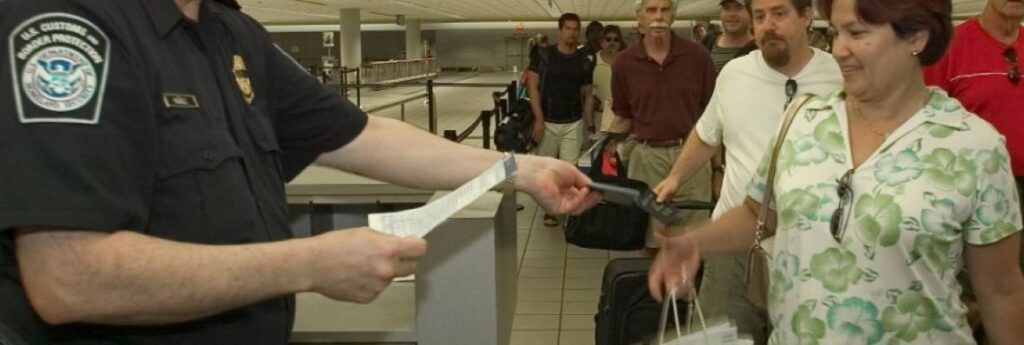
By Crystal Greene/ Inuvik resident Harley Minakis was on his way home from visiting his daughter in Costa Rica last month – transiting via “Houston” airport – when a U.S. Customs and Border Protection officer stopped him.
Despite having his Canadian passport, Indian status card, and Gwich’in tribal card, he found himself turned over to Immigration and Customs Enforcement (ICE) agents. They held him in a room for roughly two hours, he told IndigiNews, with about 20 other detainees on Jan. 22.
“‘You’re staying here,’” he recalls the agent saying, adding, “There were a whole bunch of other people that were detained in there. They were all speaking Spanish, but they look like they’re Native.”
Minakis said an agent told him his three identification documents were not enough, dismissing his federally issued Indian status card.
“One guy’s like, ‘Well, I was in Canada and they give those out like candy,’” he recalled. “I’m like, ‘How can you say that? We have to go through hoops, especially to get Indian status.’”
Officers insisted that if he wanted to be released from custody, he’d have to prove his so-called “blood quantum” of Indigenous ancestry, Minakis said.
His experience served as a reminder of the high stakes and growing fears about visiting the U.S. – anxieties shared by a growing number of Indigenous citizens within that country itself.
‘I’m scared … I’ll be detained again’
With global headlines dominated by scenes of violent arrests of migrants, including children – and agents killing two citizens protesting their actions – Indigenous people are finding themselves increasingly in the crosshairs.
A growing number of First Nations members are also being apprehended by ICE agents, sending shockwaves of anxiety across the continent on both sides of the border.
Now, as tensions on the streets flare – and resistance grows to the aggressive crackdown – multiple First Nations organizations have issued travel warnings against going to the U.S. at all.
And for those who must cross the border, they recommend people carry not only up-to-date passports – but even long-form birth certificates, Indian status cards, and a “blood quantum” letter from their band or tribal council.
In 1794, Great Britain and the newly independent U.S. signed the Jay Treaty – officially known as the Treaty of Amity, Commerce, and Navigation. The pact enshrined the inherent right of “Indians dwelling on either side of the said boundary line freely to pass and repass by land or inland navigation, into the respective territories and countries of the two parties.”
But despite nothing in the treaty about criminal records or “blood quantum,” the U.S. insists that those exercising their Jay Treaty rights must prove at least 50% blood quantum – a measure of ancestry not used to determine band membership or Indigenous identity north of the border.
“Blood quantum is a concept created by white settlers,” the Native Governance Centre states on its website, “that refers to the amount of so-called ‘Indian blood’ that an individual possesses … rooted in eugenics.”
During Minakis’s ordeal, the agents who detained him demanded more documentation, he said, before he would be released. But he alleged the agents also told him they weren’t obligated to uphold the Jay Treaty at all.
“They said they don’t have to honour it, because some bands came after it,” Minakis said.
But as he frantically tried to comply with agents’ demands, an ICE supervisor then seized his phone. Meanwhile, Minakis’s wife Aurelie sprang into action – having the Gwich’in Tribal Council draft and send a “blood quantum” letter urgently.
Thanks to their frantic efforts, eventually Minakis was released and reunited with his family, with just five minutes to spare before the gate closed for their connecting flight back to Canada.
But the ordeal left him shaken – and reconsidering whether he’s ever willing to visit his daughter in Costa Rica again, even if he never transits through the U.S.
“I’m scared that if the plane malfunctions and goes down, I’ll be detained again,” he said.
‘Taken into detention for looking a certain way’
On both sides of the colonial border, tribal and First Nations officials have issued statements advising people to make sure their status cards are up-to-date, and to have other identity documents ready for ICE encounters.
Nations in North Dakota, South Dakota and Minnesota have hosted pop-up identity document clinics in the Twin Cities area and the Native American Rights Fund (NARF) issued a fact sheet and a know-your-rights flyer.
The organization reminds Indigenous people of their right to remain silent during encounters with law enforcement – urging them to stay calm, tell the truth, and not be seen to obstruct or resist ICE agents.
If targeted, however, NARF recommends people state they do not consent to being searched, and to ask agents if they are being detained or free to leave.
Rosanna Berardi, a lawyer with Berardi Immigration Law in Buffalo, NY, was previously a border immigration inspector.
“At the beginning of my career, which was 25 years ago, there was always confusion about the Jay Treaty,” she said. “Some officers didn’t understand what that meant … it appears that there’s still that confusion. The issue with crossing the border is you just don’t know who you’re going to get and what level of experience they have.”
She advised that people can ask to speak to a border agent’s supervisor if the officer appears to not understand the Jay Treaty.
Although she acknowledges some have called for the historic treaty to be overturned, they haven’t succeeded. “Presently,” she said, “the Jay Treaty is alive and well.”
(Crystal Greene is a reporter for Canadian online publication IndigiNews)
If you enjoyed or found this story useful, we’d appreciate if you would forward it to a colleague or friend who may also enjoy it. If, on the other hand, a friend shared it with you, welcome! You can get all the latest travel news and reviews from Travel Industry by simply clicking HERE.