

By Cindy-Lou Dale/ The oldest walls in Europe don’t just hold in heat; they hold in stories. Step into a country house on a fog-slung coast or a fortress crouched in a mountain pass, and you can feel history press close: the chill of a draft that shouldn’t exist, the echo of footsteps on an empty stair, the sense that you’ve arrived late to a conversation that never ended.
Whether you come as a sceptic or a believer, Europe’s most storied homes invite visitors to examine the soft borders between memory and myth. Here are 10 legendary addresses–manors, villas, and castles – where rumour, folklore, and the historical record braid into something that still quickens the pulse.
1) Borley Rectory – Essex, England
Once trumpeted as “the most haunted house in England,” Borley Rectory began as a Victorian vicarage built in 1862 for the Reverend Henry Bull. The house burned to a shell in 1939, but its legend persists like smoke in the hedgerows. Witnesses described spectral nuns gliding along a path, phantom coaches clattering at midnight, and messages scrawled on walls pleading for “light.” Investigators came and went; accusations of trickery mingled with sincere testimony from villagers who had nothing to gain. The physical structure is gone, yet the site’s atmosphere – an orchard of absence – remains a pilgrimage for those drawn to the origin story of modern English ghost lore. Whether you call it hysteria, hoax, or haunting, Borley is where the template was cast.
Traveller’s note: The rectory no longer stands, and the site is on private land. Respect boundaries and seek local heritage groups for context rather than trespassing for thrills.
2) Raynham Hall – Norfolk, England
Few images in paranormal history carry the cultural weight of the 1936 “Brown Lady” photograph from Country Life magazine, said to depict a figure descending the grand staircase at Raynham Hall. The house itself – an early-17th-century mansion of red brick and symmetry – anchors its legend in an era of powdered wigs and candlelit corridors. The spirit is often identified as Lady Dorothy Walpole, who allegedly suffered a tragic fate within the house’s walls. Raynham remains a lived-in country home first and a legend second, which may be precisely why its stories endure: hauntings feel more plausible where ordinary life quietly continues, and hallway portraits today watch over laptops and schoolbooks as well as candelabra.
Traveller’s note: Raynham Hall is privately owned but has offered limited tours and special events. Check ahead and approach with the same graciousness the house itself exudes.
3) Chillingham Castle – Northumberland, England
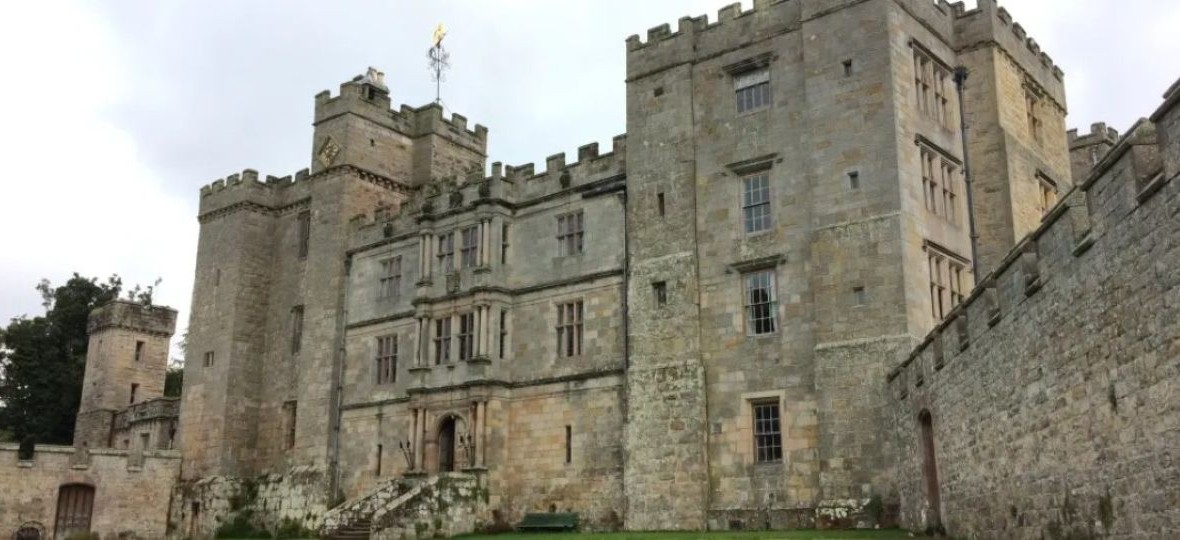
With a name that reads like a dare, Chillingham rises from England’s far north, a crenelated thicket of towers and battlements that once guarded the Anglo-Scottish frontier. Its ghosts are a cast with range: the moaning “Blue Boy,” spectral monks, and disembodied voices from a medieval dungeon. Curators lean into the lore – armour stands gleam; a torture chamber exhibits iron devices that are as instructive as they are unsettling. But the haunting at Chillingham is also architectural: doorways reveal doorways that reveal staircases to nowhere, a built environment that authorizes the idea of hidden lives.
Traveller’s note: Chillingham welcomes visitors seasonally and offers evening ghost tours. You can even stay overnight – an experience that blurs tourism and time travel in the best way.
4) Leap Castle – County Offaly, Ireland
If castles can possess moods, Leap’s is equal parts stern and sorrowful. Built in the 13th century by the O’Bannon clan and later controlled by the O’Carroll’s, it earned a blood-soaked reputation. The Bloody Chapel witnessed fratricide; an oubliette revealed a morbid scatter of human remains when opened centuries later. Sightings range from floating lights to a uniquely unnerving presence known as The Elemental, a shape said to announce itself with a sulfuric smell and a surge of dread. And yet a private home still hums within these walls. Music sometimes drifts from its rooms, as the owner repairs and polishes the long history.
Traveller’s note: Leap is a private residence; visits are often by arrangement. When open, you’ll find storytelling at its source – measured, respectful, and saturated with local memory.
5) Loftus Hall – Hook Peninsula, Ireland
On a wind-hammered finger of County Wexford, Loftus Hall looks out to a restless sea. Rebuilt in the 19th century atop a 14th-century foundation, the mansion’s silhouette – mansard roof, balustrades, and that dramatic central tower -feels theatrical enough to stage its most enduring tale: a stormy-night card game with a handsome stranger whose cloven-hoofed reveal branded the house forever. More historically grounded are reports of grief echoing through the rooms after a young woman’s confinement and death. When you stand before Loftus and the wind presses the coat to your ribs, even sceptics can admit the environment conspires effectively with story.
Traveller’s note: Loftus Hall has changed hands and access has varied. If tours are on hiatus, consider the peninsula’s wider heritage trail, where the house’s facts and fictions are part of a larger coastal chronicle.
6) Château de Brissac – Loire Valley, France
France’s tallest castle by façade, Brissac is an elegant dendrochronology in stone – medieval roots beneath a flamboyant 17th-century crown. Its resident spectre, the “Green Lady,” is linked to a Renaissance-era crime of passion, her presence reportedly noticed by soft weeping and the rustle of silk. The marvel of Brissac is its duality: salon after salon of trompe-l’œil opulence and family portraits, set against a legend whose emotional register is intimate rather than operatic. At dusk, the vineyards go quiet, and the château’s windows gather the last gold of the day like eyes.
Traveller’s note: Brissac is open to visitors, with some rooms still part of a lived-in residence. Wine tastings and gardens round out the experience – proof that history and hospitality can be companions.
7) Houska Castle – Bohemian Highlands, Czech Republic
Houska was built, so the legend goes, to plug a hellmouth. In a forested solitude north of Prague, the 13th-century castle famously defies defensive logic: walls turned inward, no water source, no strategic purpose. That oddity nourishes its mythology – stories of winged creatures, prisoners lowered into a chasm whose screams curdled, and a chapel planted like a lid atop the supposed abyss. The rational explanation points to administration and prestige rather than demons. Still, as wind combs the trees around this architectural riddle, you will understand how landscapes foster narratives as surely as battlements do.
Traveller’s note: Day trips from Prague are common. Guides balance legend with scholarship, letting you test the resonance of each for yourself.
8) Dragsholm Slot – Odsherred, Denmark
Dragsholm wears multiple crowns: medieval citadel, Renaissance palace, elegant hotel. Its spectral trinity is almost pedagogical in scope: a Grey Lady (benevolent guardian), a White Lady (romance curdled into tragedy, discovered walled within), and a nobleman prisoner – James Hepburn, the 4th Earl of Bothwell – whose clanking cavalry allegedly circles the courtyard at night. Here the haunting functions as an index to the building’s evolutions. Walk the corridors and your footsteps cross centuries of repurposed power, from feudal fortress to stately lodging.
Traveller’s note: Stay the night. If you’re more interested in gastronomy than ghosts, the restaurant’s seasonal menus draw deeply from the surrounding fields and fjords – another kind of communion with place.
9) Moosham Castle – Lungau, Austria
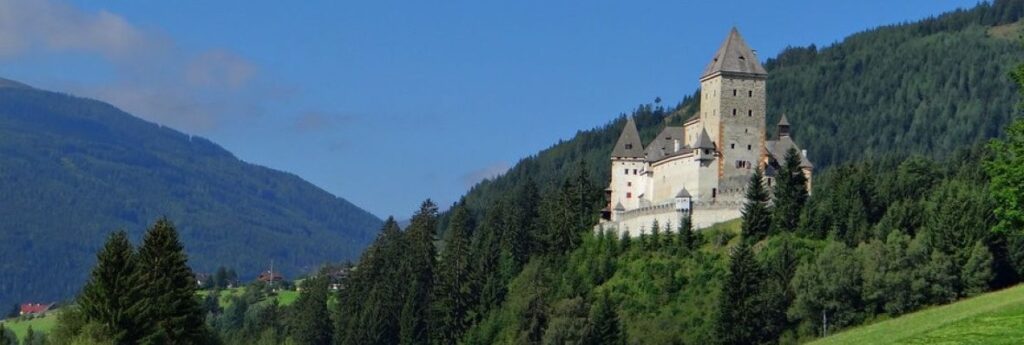
Salzburg’s 17th-century witch trials give Moosham its darkest association, though the castle predates them by centuries and served various lords and bishops. The surrounding forest feels thick enough to keep secrets; the castle museum exhibits antlers, icons, and tools of governance alongside rumours of a werewolf that plagued nearby villages. As in many Alpine strongholds, the boundary between record and legend is porous. What is undisputed is the severity of early-modern justice and the power of an echoing corridor to repopulate itself with the condemned.
Traveller’s note: Moosham is accessible in summer and early autumn. The tour leans historical; the haunting hangs like fog you walk through on the way to the next room.
10) Villa De Vecchi – Cortenova, Italy
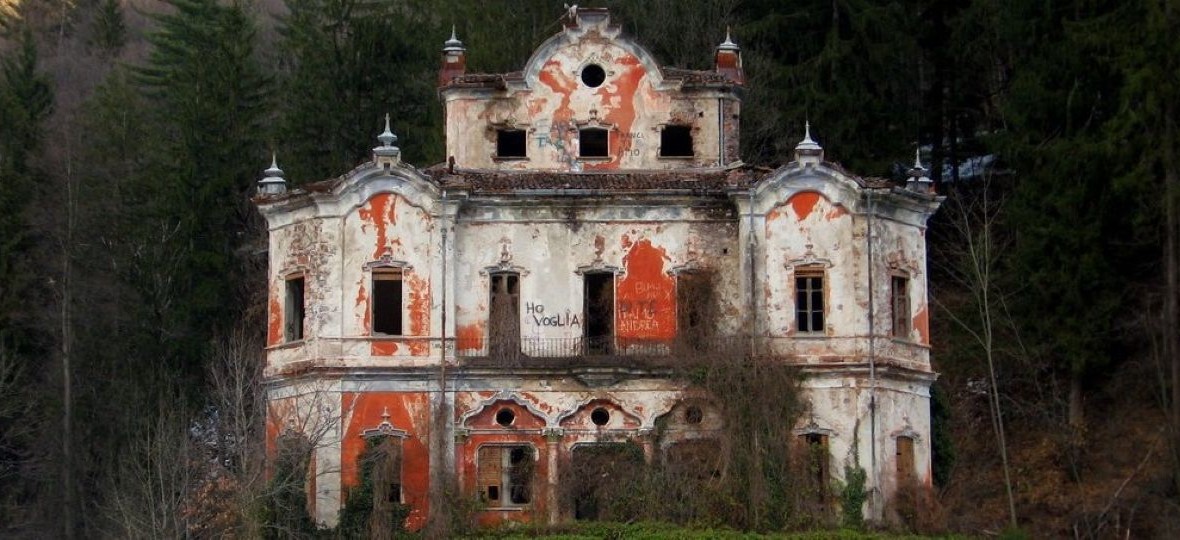
They call it the Red House, though time has faded its tones to a weathered blush. Built in the 1850s for Count Felice De Vecchi, the villa once boasted frescoes, a grand piano, and terraced views into the Valsassina. Abandonment and vandalism have gnawed it down to a romantic skeleton, the kind of ruin that rearranges the light around itself. Local tales speak of a family tragedy and a lingering melancholy; some swear music filters from the empty salons. Whether or not the piano plays by itself, Villa De Vecchi illustrates a truth about hauntings: neglect can be as evocative as any apparition.
Traveller’s note: The villa is unsafe and off-limits. View from a distance, and let the mountains frame your meditation on beauty, loss, and the urgency of preservation.
Why these houses haunt us
It’s tempting to read the supernatural as pure entertainment – candles blowing out, portraits whose eyes seem to follow. But the best haunted houses double as history lessons, compact museums of their nations’ anxieties and aspirations.
Across our list, a pattern emerges. First, many hauntings are domesticized – women in white, lovers parted, families torn by inheritance or ambition. Ghost stories act as ethical reckoning, assigning narrative weight to lives overlooked by official histories.
Second, architecture matters. A staircase invites a descending figure; a chapel over a pit becomes a thesis about good and evil. The built environment is not neutral – it sets the stage, writes the lighting cues, and hands the actors their marks.
And finally, community is the true medium of any haunting. These tales survive because caretakers, owners, and neighbours keep telling them – with caveats, with eyerolls, with awe.
Haunted houses linger in the imagination because they invite us to practice a specific, endangered skill: attention. When we slow down – when we notice drafts, commas of dust, the way a corridor frames the world into perspective – we become better readers of time. Whether a place is truly haunted may be less important than the fact that it refuses to yield all its meanings at once.
In that sense, the ghosts are us: our insistence on coherence, our tenderness for the people who came before, our desire to be remembered by the rooms we once warmed.
If you go, go with curiosity. Carry both questions and kindness across the threshold. And when you leave, step out into the daylight with the old house still behind you, steeped in story, waiting for the next set of footsteps to teach it how to speak again.
How to visit – responsibly
Not every site on this list is easily accessible, and some are private homes. Before you set out, confirm visiting hours and ownership status. Where tours are available, book with local guides who balance folklore and fact; they are interpreters of both stone and story. If an address is closed or unsafe, honour the boundary.
The point is not to bag a spectral sighting, but to experience how the physical world – masonry, landscape, light – amplifies the unseen. Bring empathy as well as a camera. These are not horror-movie sets; they are lived-in places, working estates, or fragile ruins with burdens to carry.
If this article was shared with you by a friend or colleague, you may enjoy receiving your own copy of Travel Industry Today with the latest travel news and reviews each weekday morning. It’s absolutely free – just CLICK HERE.