


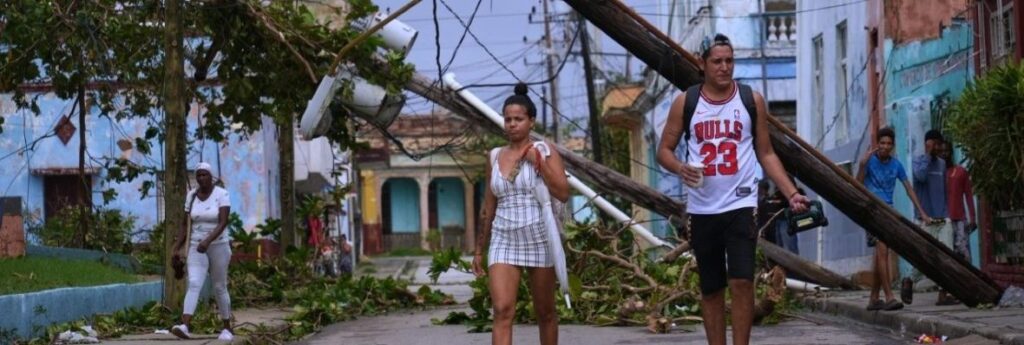
Hurricane Melissa – one of the strongest Atlantic hurricanes on record – left dozens dead and a trail of destruction across Cuba, Haiti and Jamaica, where roofless homes, toppled utility poles and water-logged furniture dominated the landscape Wednesday.
Melissa made landfall Tuesday in Jamaica as a catastrophic Category 5 storm with top winds of 185 mph (295 kph) before weakening and moving on to Cuba, where officials reported collapsed houses, blocked mountain roads and roofs blown off buildings Wednesday, with the heaviest destruction concentrated in the southwest and northwest. Authorities said about 735,000 people remained in shelters.
“That was hell. All night long, it was terrible,” said Reinaldo Charon in Santiago de Cuba. The 52-year-old was one of the few people venturing out Wednesday, covered by a plastic sheet in the intermittent rain.
People in the eastern Cuban province of Santiago de Cuba began clearing debris around the collapsed walls of their homes Wednesday after Melissa made landfall in the region hours earlier.
Cuba’s National Institute of Hydraulic Resources reported accumulated rainfall of 15 inches (38 cm) in Charco Redondo and 14 inches (36 cm) in Las Villas Reservoir.
The tourist board’s office in Toronto said on Wednesday that storm had weakened to a Category 2 hurricane after moving through the eastern part of the country and continued through through the province of Holguín with reduced intensity, though still delivering intense rainfall and strong winds.
The board reported that as of Monday, tour operators had executed repatriation flights, leaving only 33 tourists (including Canadians) remaining in Holguin, all of whom were safely evacuated to the Brisas Guardalavaca Hotel.
Additionally, clients who had booked travel to Holguín since Monday and opted not to change their travel plans were successfully relocated to Cayo Coco.
All other popular tourist destinations, including Jardines del Rey, Varadero, Cayo Santa Maria , Cayo Largo, Cienfuegos, Trinidad and Havana remain fully operational.
The temporary closures of airports in Santiago de Cuba and Holguín are still in effect and passengers should continue to consult with their travel agent or airline for specific flight information, the office added.
Jamaica
In Jamaica, more than 25,000 people were packed into shelters Wednesday and more streamed in throughout the day after the storm ripped roofs off their homes and left them temporarily homeless. Dana Morris Dixon, Jamaica’s education minister, said that 77% of the island was without power.
Outages complicated assessing the damage because of “a total communication blackout” in areas, Richard Thompson, acting director general of Jamaica’s Office of Disaster Preparedness and Emergency Management, told the Nationwide News Network radio station.
Prime Minister Andrew Holness said in a statement that teams are working to rescue people and bring relief where it’s needed the most.
“Recovery will take time, but the government is fully mobilized,” he said. “Relief supplies are being prepared, and we are doing everything possible to restore normalcy quickly.”
Officials in Black River, Jamaica, a coastal town of approximately 5,000 people in the southwestern part of the island, pleaded for aid at a news conference Wednesday.
“Catastrophic is a mild term based on what we are observing,” Mayor Richard Solomon said. “I need help,” he begged.
The government said it hoped to reopen Jamaica’s airports as early as Thursday to ensure quick distribution of emergency relief supplies.
The United States is sending rescue and response teams to assist in recovery efforts in the Caribbean, Secretary of State Marco Rubio announced on X. He said government officials were coordinating with leadership in Jamaica, Haiti, the Dominican Republic and the Bahamas.
Bahamas
Moving toward the Bahamas Wednesday afternoon, Melissa had top sustained winds of 100 mph (155 kph).
Michael Brennan, director of the National Hurricane Center, said the storm began affecting the southeastern Bahamas on Wednesday.
“The storm is growing in size,” Brennan said, noting that tropical storm force winds extended almost 200 miles (320 km) from the centre.
Melissa’s centre was forecast to move through southeastern Bahamas later Wednesday, generating up to 7 feet (2 m) of storm surge in the area. By late Thursday, Melissa was expected to pass just west of Bermuda.
Authorities in the Bahamas were evacuating dozens of people from the archipelago’s southeast corner ahead of Melissa’s arrival.
“We’ve had about five flights so far,” said Alex Storr, executive chairman of the Bahamas’ Disaster Management Authority. He said officials expect at least four more flights later Wednesday.
If this article was shared with you by a friend or colleague, you may enjoy receiving your own copy of Travel Industry Today with the latest travel news and reviews each weekday morning. It’s absolutely free – just CLICK HERE.