


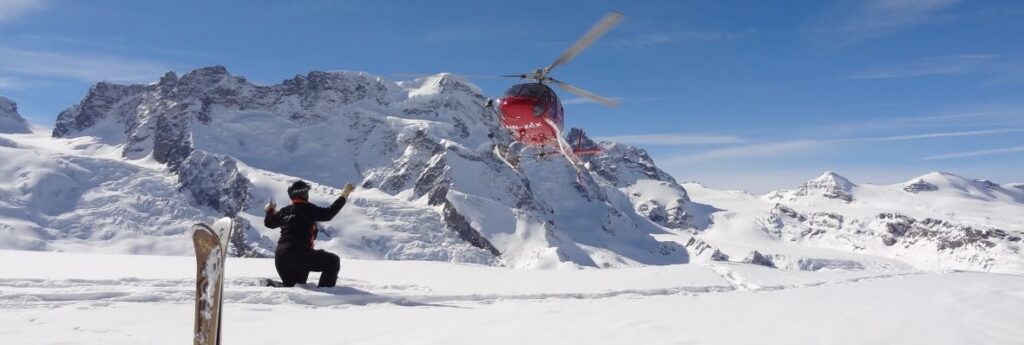
By David Koo/ When most people picture an emergency medical evacuation, they imagine flashing lights, sirens and helicopters landing on a hospital rooftop. That’s the Hollywood version. In reality, the farther you travel from civilization, the stranger – and more inventive – an emergency medical rescue becomes.
In the world’s most remote corners, your stretcher might be a hammock strung among bamboo poles. Your lifeline might be a Sherpa guiding you down a mountain at midnight, a bush plane carving through Arctic winds and a speedboat threading coral reefs in the dark.
As a former combat medic, I’ve learned this simple truth: medical evacuations are never cookie-cutter. Every rescue requires resourcefulness, urgency and a team that won’t quit until the patient is safe.
Most travel protection companies require you to make it to a hospital before their coverage even kicks in. But what if you break a leg on a dangerous volcano or collapse with altitude sickness at more than 26,000 feet? Getting to a hospital is the problem.
That’s where a two-step rescue starts; first, with emergency field rescue and then with medical evacuation to the patient’s home hospital of choice for continuing care.
Here’s what it looks like: Field rescue from the point of illness or injury means we don’t wait for you at the emergency room doors – rather, we get you to safety. Whether you’re in a rugged, isolated, or hostile environment – if the location is reasonably accessible – our team will get you out of danger and to safety. From there, the patient is medevacked to the most appropriate hospital capable of handling the illness or injury. Rarely are those resources close, often they are hundreds, even thousands, of miles away.
These rescue missions are often unconventional.
A corporate executive and seasoned adventurer who had climbed Mount Fuji, trekked Kinabalu and walked across Europe needed emergency rescue on Indonesia’s Mt. Tambora – the same volcano whose eruption changed the world’s climate in 1815. She misstepped into a hidden hole. She heard the crack before she felt the pain: a broken leg.
With no chance of a helicopter landing and darkness closing in, the local team bivouacked for the night. At first light, porters arrived with bamboo poles and sarongs. They fashioned a mobile hammock stretcher and carried her five kilometers down the volcano. From there, we coordinated a flight to Jakarta and arranged for one of our nurses to stay with her through surgery and recovery. That rescue wasn’t high-tech. It was human ingenuity backed by professional coordination.
In Peru’s Quelccaya Glacier, a climber went snow-blind in whiteout conditions. Helicopters couldn’t fly at that altitude, so we sent in a ground team. Their secret weapon? A mule.
It wasn’t fast or glamorous, but it worked. The mule carried the mountaineer down to safety, proving that sometimes the humblest solutions are the most effective.
The Indonesian archipelago is paradise for surfers and divers – until something goes wrong. A surfer in the Mentawai Islands suffered a serious eye injury after his board struck him. With permanent blindness a real possibility, we arranged a private speedboat to ferry him hours across rough seas to Sumatra. He made it to surgery in time, and his vision was saved.
In places where tides matter more than timetables, speedboats can mean the difference between disability and full recovery.
At 26,545 feet, Annapurna 1 is notorious for its deadly slopes. A climber who had just summited developed high-altitude pulmonary edema – lungs filling with fluid. Night was falling, helicopters couldn’t land and every breath was a struggle.
A Sherpa guided him down 3,000 feet to a lower camp where we arranged a long-line helicopter extraction. Suspended on a cable beneath the aircraft, he was flown to base camp and then stabilized in hospital. Without that Sherpa’s strength and the precision coordination of our operations centre, he would not have survived.
Not all crises are medical. Sometimes it’s geopolitics that traps travellers. When civil war erupted in Sudan, Port Sudan became a dangerous bottleneck. With roads cut off and commercial flights grounded, tourists and businesspeople were stuck.
We organized a maritime evacuation: a yacht capable of crossing 600 miles of open sea to Egypt. This wasn’t a pleasure cruise; it was a race against advancing conflict. For those on board, the sight of Alexandria’s harbor was salvation.
In the Canadian Arctic, a researcher suffered severe burns from a lab accident. There were no roads, no ambulances – just frozen wilderness. We deployed a bush plane to land on a rough strip near the outpost, evacuating the victim to a hospital. He later returned home to Seattle for advanced treatment.
Out there, hours matter. Without that bush plane, he would have faced permanent damage, even death.
Whether it’s a mule on a glacier, a hammock on a volcano or a yacht on the Red Sea, field rescues and medical evacuations are turnkey. Travel is one of life’s greatest joys. But when things go wrong far from home, you need someone who can move heaven and earth to bring you back safely.
(David Koo is the director of operations for Global Rescue and a former combat medic).
If this article was shared with you by a friend or colleague, you may enjoy receiving your own copy of Travel Industry Today with the latest travel news and reviews each weekday morning. It’s absolutely free – just CLICK HERE.