


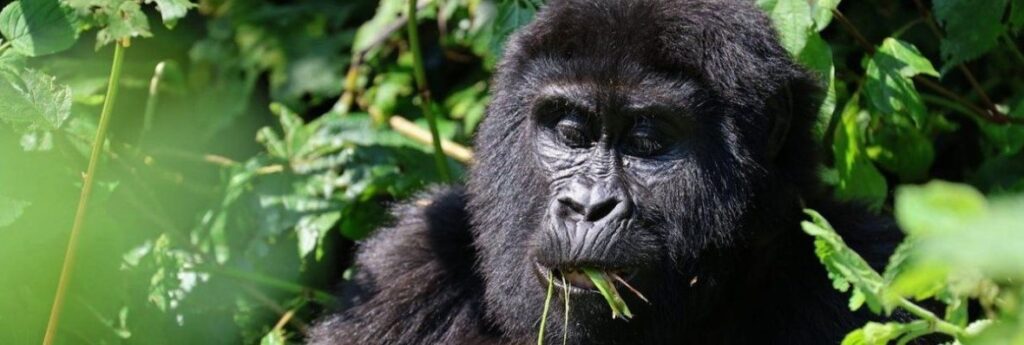
News of a sick or injured mountain gorilla can worry local residents in mountainous area of Uganda that’s home to the endangered species. That’s partly because most of the gorillas have been given names, allowing rangers and others to humanize the animal’s suffering. But widespread interest in protecting mountain gorillas also comes from the economic benefits of tourism that have turned poachers into conservationists, married women into porters and rangers into eloquent spokespeople for the great apes.
“If we know there is a gorilla that is sick, you see everyone is concerned. ‘Why? Why is the gorilla sick? It’s suffering from what?’” says Joyleen Tugume, a ranger-guide in Bwindi Impenetrable National Park. “Even the community people. Everyone is touched.”
Tugume and many others marked World Gorilla Day this week (Sept. 24), having been launched in 2017 to coincide with the 50th anniversary of the establishment of a Rwanda-based gorilla study centre founded by Dian Fossey, the American primatologist and conservationist who gained global renown for her research.
Gorillas are losing their habitat because of poaching and other threats and the International Union for Conservation of Nature lists both gorilla species as endangered, with three of four subspecies critically endangered.
Bwindi, a UNESCO World Heritage Site in a remote part of southwestern Uganda, is home to many groups of habituated gorillas that have become comfortable in the presence of humans.
And Tugume says poaching in the park is increasingly rare since “we are actually all working together to make sure conservation goes well, because we are all benefitting.”
Vibrant tourist economy
Tourists pay a considerable sum – $800 in permit fees per foreign non-resident – for the right to see gorillas in their natural habitat. An official revenue-sharing policy channels $10 from each permit back to the local community via their elected leaders, who can invest in projects ranging from water provision to health care. Local communities are also entitled to 20% of all park entry fees generated annually.
Many locals, including reformed poachers living near the park, say that the money generated has ensured the recovery of the species, with habitat encroachment and poaching in decline as wildlife authorities seek to collaborate more with nearby communities.
Philemon Mujuni, a poacher until five years ago, said he once thought of the gorilla as a hostile animal to be killed before it killed him if he ever encountered one. As a boy, he used to follow his father, whom he described as “a senior poacher,” into the forest to help carry the antelopes they pulled from traps.
But in 2020, when poachers killed a beloved gorilla named Rafiki, Mujuni and others formed an organization of former poachers who now say the primates are more important than any other animal.
They serve as community watchdogs, looking out for people who might venture into the forest to set duiker traps that sometimes ensnare gorillas. Their surveillance efforts help support the work of armed rangers who also regularly patrol the park.
“When community conservation rangers sensitized us, we said, ‘Let us reform and stop poaching in the national park of Bwindi,’” Mujuni said. “I can’t go there. Because, through the conservation team from (Bwindi Impenetrable National Park), we get some money from these gorillas we could kill.”
Peter Tumwesigye, one of 128 members of the group of reformed poachers, said gorillas are so important that people whose actions lead to a gorilla’s death should be jailed. “So that others can learn and never do it again,” he said.
Many of the world’s remaining mountain gorillas live in the Virunga Massif, a mountainous area encompassing parts of Congo, Uganda and Rwanda.
Positive outlook
The outlook for mountain gorillas has been positive since 2018, when a survey showed that the population exceeded 1,000. It’s a remarkable comeback for a species that faced extinction in the last century.
The International Union for Conservation of Nature, which maintains a list of threatened species, cites the mountain gorilla as endangered, an improvement from its earlier designation as critically endangered. About half of the gorillas live in Uganda.
Besides Bwindi, the only other Ugandan park where gorillas can be tracked in the wild is Mgahinga Gorilla National Park. But that protected area has just one family of gorillas, while Bwindi has 27 groups that can be seen up close by visitors.
The primates are tracked daily. Tugume, the ranger-guide, said she works even on Christmas Day. One recent morning she led a small group of tourists into the forest, swinging a sickle to clear the way and speaking of the tenderness she sees in gorillas.
At the offices of the Uganda Wildlife Authority in Buhoma, a town outside the park, a group of ranger-guides and porters gathers each morning for the opportunity to earn generous tips from helping tourists navigate the forest.
Groups of trackers are allocated porters, who can even help carry an unfit tourist up the hills and through the undergrowth for around $300.
“The value of the gorilla money is very critical,” said Gessa Simplicious, a conservationist with the Uganda Tourism Board. “It helps with building trust, but it also helps in the awareness of the need to conserve.”
If this article was shared with you by a friend or colleague, you may enjoy receiving your own copy of Travel Industry Today with the latest travel news and reviews each weekday morning. It’s absolutely free – just CLICK HERE.