


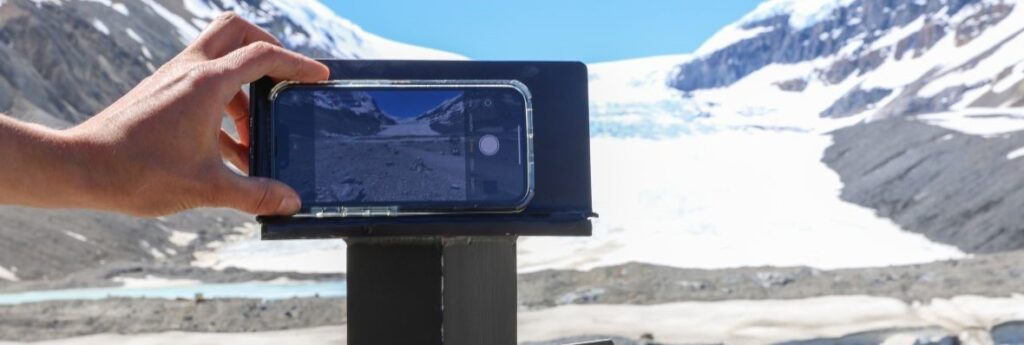
When you take a photo of yourself, that’s a selfie. When you take a cool photo of a glacier, that’s an “Icy,” says Parks Canada, which has launched a community science program dubbed the Icy Initiative that allows park visitors to help scientists monitor glacier change over time simply by taking and submitting photos in two national and three provincial parks across the country.
Supported by the federal government in partnership with Parks Canada, British Columbia Parks, and the BC Parks Foundation, and the University of Waterloo, the project “makes every participant a contributor to vital environmental research, while capturing some stunning shots and making unforgettable memories along the way!”
Cell phone stands have been installed at select glacier viewpoints, with more to come. Visitors simply place their phone in the provided holder, capture a photo of the glacier, and submit it via the QR code on-site or through the GeoReach website at www.georeach.ca. Clear instructions at each location will guide participants through the process.
Submitted photos will be analyzed by researchers at the University of Waterloo to track glacial changes such as retreat, thinning, and disappearance – offering valuable insight into the impacts of climate change.
The Icy Initiative launches in Jasper and Glacier national parks, as well as Bugaboo, Garibaldi, and Mount Robson provincial parks. Each site will feature one to three Icy stands, creating unique opportunities for visitors to engage with glacier science.
This initiative builds on the success of the Coastie program, launched in 2021, where visitor-submitted photos help monitor coastal changes in Atlantic Canada.
“In this UN International Year of Glaciers’ Preservation, our government and Parks Canada are proud to invite Canadians to connect with the beauty and power of the iconic glaciers we are so fortunate to have in Canada,” said Identity and Culture minister Stephen Guilbeault. “Through the Icy Initiative, visitors become part of the story – helping us understand and protect these precious natural wonders in the face of climate change.”
Quick Facts
- Canada is home to a significant percentage of the world’s glaciers, with vast ice fields in both Western and Northern Canada.
- Glaciers worldwide are melting – and in Western Canada, they’re retreating faster than ever.
- Northern Canada is home to some of the largest ice caps outside of the polar regions, which are critical to understanding long-term climate patterns.
- Glaciers are a crucial source of fresh water in Western Canada, releasing water into ecosystems during dry summer months. As they retreat and shrink, the reduction of water runoff will impact water tables, agricultural practices, and even drinking water availability downstream.
- Jasper National Park is the largest national park in the Canadian Rockies. Known for its wildlife, glaciers, and breathtaking peaks, it’s also a hub for important climate change research. Recent data from the Athabasca Glacier shows consistent melt each year, but more ice melt in 2023 than in the past decade.
Learn more about the Icy initiative HERE.
If this article was shared with you by a friend or colleague, you may enjoy receiving your own copy of Travel Industry Today with the latest travel news and reviews each weekday morning. It’s absolutely free – just CLICK HERE.