


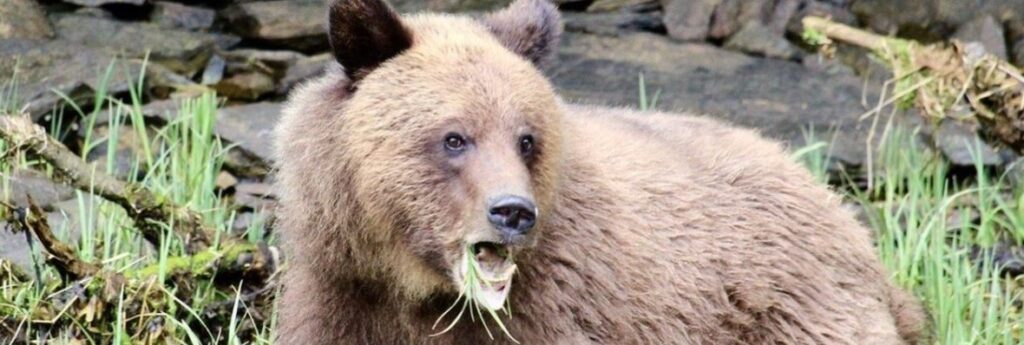
Hidden deep in northwest B.C.’s coast lies the lush inlet of the Khutzeymateen, bustling with grizzly bears and other rich fauna. Created in 1994 as the first specially protected area for grizzly bears and their habitat in Canada, it is widely regarded as the densest natural grizzly bear habitat in North America and is accessible only by boat or plane.
Located about 45 km. northeast of Prince Rupert and only, the area became protected through an agreement with the B.C. government and the Tsimshian First Nation three decades ago, helping to conserve the resident grizzly bear population as well as preserving the social, ceremonial, and cultural uses of the Coast Tsimshian who depend on the area.
Two rangers from the Tsimshian Gits’iis tribe are situated at the K’tzim-a-deen Ranger Station at Khutzeymateen Inlet and they keep track of bear sightings and any commercial activity, monitoring people’s behaviours around the bears and staying involved in the ecology of the area.
Each year from May to the end of July, Prince Rupert Adventure Tours takes passengers on their yellow catamaran to one of the only places on the planet where grizzly bears can be observed in their natural habitat, living freely in the wilderness.
Khutzeymateen is also a vibrant haven for bald eagles, seals, sea lions, orcas, humpback whales and mountain goats, while coastal wolves also roam the rugged landscape. Nearby waters invite glimpses of majestic whales and playful dolphins, showcasing the area’s rich biodiversity.
The bears of Khutzeymateen
Jasmine Newton, a tour guide with Prince Rupert Adventure Tours, says between the 40 to 50 bears that roam the 45,000-hectare sanctuary, some of them can be territorial.
The sanctuary mainly has grizzlies, but there have been sightings of black bears before. However, grizzlies do not like to associate with black bears, so when their paths do cross – typically at the beginning of the season right when grizzlies come out of hibernation – it can be fatal for black bears.
“Some of the bears are transitory, so they’ll move in and out. Most of them are resident bears,” says Newton. “They’ll have their dens up in the alpine habitats, and they’ll stay there for five months out of the year. The rest of the time, they’re down along the shorelines hunting for salmon.
“From July onwards, they’re looking for berries. They like things like skunk cabbages and bulbous roots, and sedge grass is a really important part of their diet.”
They also forage for shellfish and clams and consume about 40 to 60 pounds of protein-rich sedge grass each day.
Under threat
“Grizzly bear habitat used to be all over North America, specifically in B.C. It used to go all the way down to Vancouver. But they’ve been pushed out of their territory by human encroachment, building cities and especially extractive industries like pipelines. This is one of the last intact grizzly bear habitats in North America,” said Newton.
Overfishing in northern coastal waters also poses a significant threat to the grizzlies, the salmon populations and the sanctuary itself.
Newton explains, “Without the healthy salmon populations, the bears would not survive here. The reason the bears do so well here and on a broader level, in northern B.C., is because we have some of the largest intact rivers here, like the Skeena and the Nass.”
Eco-tourism
BC Parks, Lax Kw’alaams and Commercial Bear Viewing Guides work in collaboration to ensure the Khutzeymateen Protected Areas are managed proactively and public access be monitored conservatively to ensure the grizzly bears and their habitats are the first priority.
In 1994, Captain Doug Davis founded, Prince Rupert Adventure Tours, a marine ecotourism business to showcase the amazing wildlife and scenery of the Pacific Northwest.
Bear viewing guides, like Captain Davis’, contribute a per person donation to the Khutzeymateen Park Enhancement Fund (KPEF), which supports shared stewardship initiatives for the area.
“Any tourism business at its core is a little bit extractive. There is always going to be some impact, whether that be from our fuel emissions or our presence itself. But, I think our impact is very minimal,” said Newton.
“It’s all on a sliding scale in my brain for tourism, because if you look down south in the Victoria and Vancouver area, whale watching has been detrimental, especially to the southern resident killer whales,” she said. “Up here, it’s not exactly the same because we’re the only tourist boat of this scale for hundreds of kilometres.”
She added, “The boat was custom-made to minimize sound disturbance underwater and above water for the bears, and to prioritize fuel efficiency.”
The captain says bear sightings have been fairly steady throughout his 30-year career. The month of May also witnesses the mating season.
The tour typically sees between five and 10 bear sightings each trip. However, every day is different with no guarantees. The tour boat observes precautions to minimally disturb the environment around it.
Its primary goal was to leave the grizzly bears and the inlet in the same natural state they found it.
If this article was shared with you by a friend or colleague, you may enjoy receiving your own copy of Travel Industry Today with the latest travel news and reviews each weekday morning. It’s absolutely free – just CLICK HERE.