
Since starting in 2011, the Jasper Dark Sky Festival has steadily grown in popularity and become a signature event for Jasper National Park. Dark sky tourism, a subset of ecotourism, is focused on experiencing the night sky in areas with minimal light pollution and allowing visitors to appreciate natural phenomena such as auroras and eclipses.
Hosted by Tourism Jasper, the Jasper Dark Sky Festival runs for over two weeks in October and aims to draw visitors to Jasper during the fall shoulder season.
Activities include stargazing, guest speakers, night hikes, Indigenous cultural awareness events, indoor planetarium tours, fireside storytelling, musical performances, drone shows and more.
Hvenegaard and his colleague Clark Banack gathered data by attending the festival themselves in 2022 and 2023, conducting interviews with insiders and searching for festival activities mentioned in online sources.
In 2011, Jasper was designated as a Dark Sky Preserve by the Royal Astronomical Society in Canada, due to its limited light pollution that creates ideal conditions for dark sky viewing.
This designation was identified as one of the factors that help explain the festival’s success, along with developing a balance between traditional educational programming and “info-tainment.”
“There’s always a little bit of a balance or tension between promoting speakers and information around dark sky, celestial issues, astronomy versus space-adjacent kinds of topics like extraterrestrials or space travel,” says Glen Hvenegaard, a professor of environmental science at the University of Alberta and author of a new study on Dark Skies tourism.
Although the study was conducted prior to the Jasper wildfire, it acknowledged that the disaster would undoubtedly affect the future of the festival and had already caused last year’s festival to be scaled down.
A more perennial challenge with the festival is the uncertain weather, which may necessitate some indoor programming.
“The month of October, generally, is pretty good, but they’ve had times where the festival had temperatures dropping down to minus teens and 20s, but most often it’s reasonable,” Hvenegaard said.
While Jasper already has plenty of tourism infrastructure in place, including an observatory at the Jasper Park Lodge, Tourism Jasper CEO Tyler Riopel noted the study reinforced the notion that the use of events and the natural environment was an effective way to promote tourism and education.
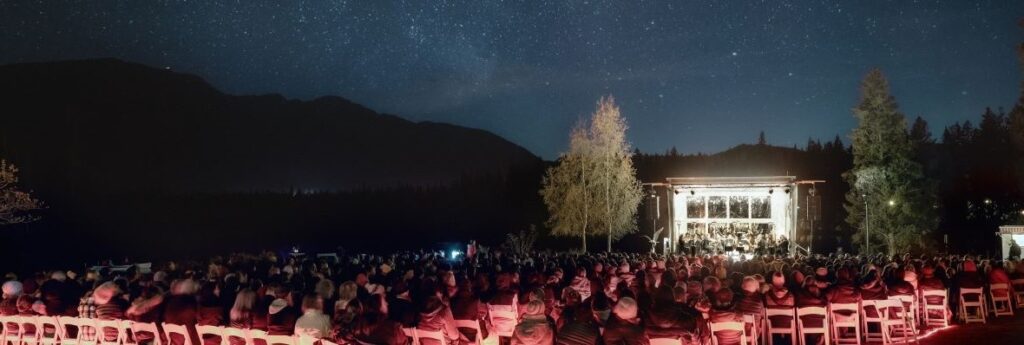
Last year the festival featured such events as Symphony Under the Stars, an improv comedy show, performances by Indigenous artists, trivia night, and more.
“What may have started as an education opportunity has turned into an opportunity not just to educate but also to entertain, and that’s pretty much the natural evolution of events, and that seems to be what the study showed as well,” Riopel said.
He attributed the growing popularity of the festival to an increased interest in dark skies and STEM (science, technology, engineering, and math) and Jasper’s ability to tap into this niche market.
Riopel also agreed that the festival should focus on educating the public while also attracting tourists.
“A big takeaway that I got from this specific study was the idea that we have to ensure that we continue to be aligned with the notions of environmental stewardship, in this case, dark sky stewardship,” he said.
Although last year’s festival was a smaller affair, Tourism Jasper is anticipating that the festival will make a proper comeback for its 15th anniversary (Oct. 17-Nov. 2, 2025).
“We think it’d be a wonderful way to have that full festival again because we do feel that we missed the ability to have that full festival this past October,” Riopel said. “Everybody is in alignment, and we’re already hard at work planning and absolutely looking forward to it.”
If this article was shared with you by a friend or colleague, you may enjoy receiving your own copy of Travel Industry Today with the latest travel news and reviews each weekday morning. It’s absolutely free – just CLICK HERE.